
On this page
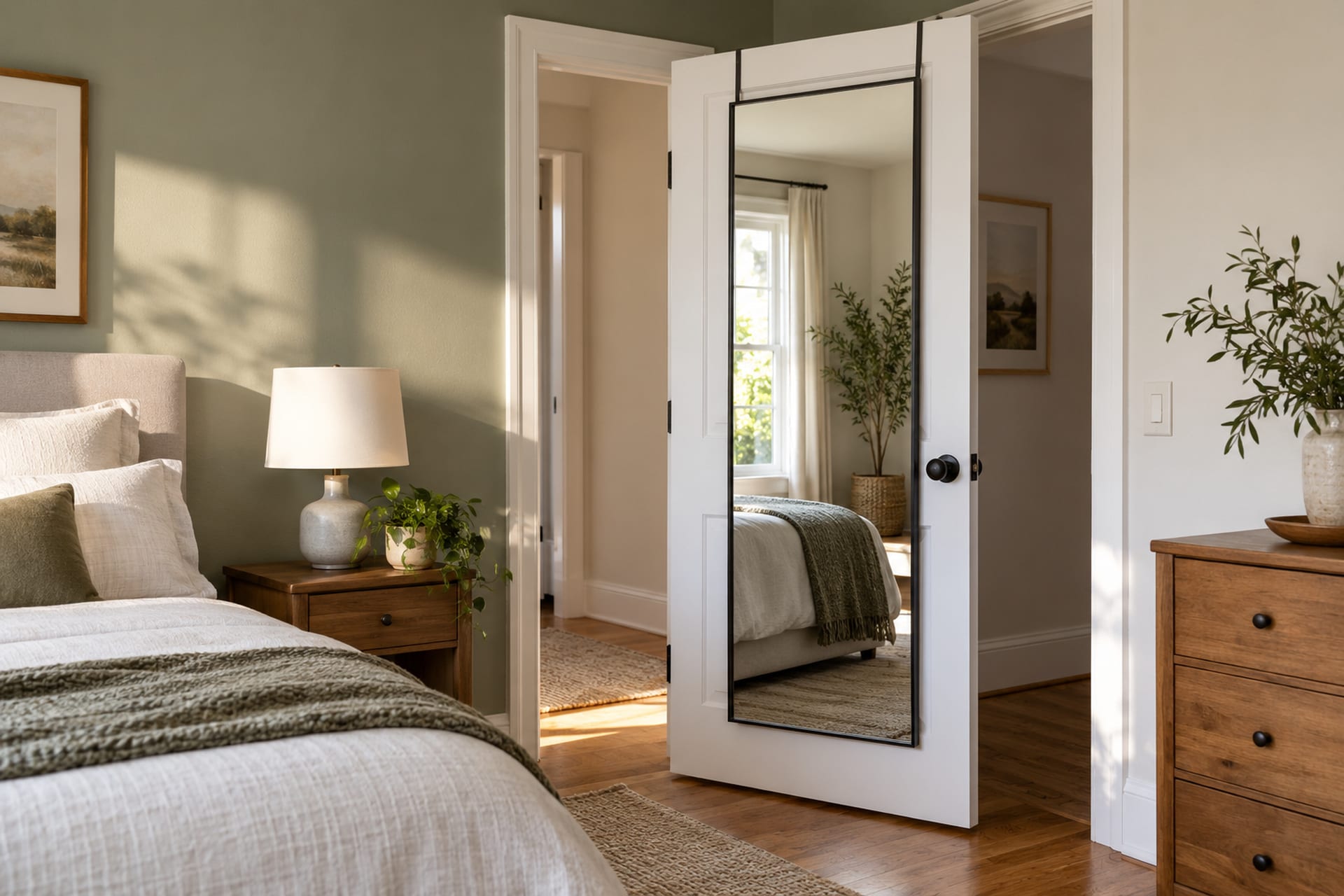
A door is the easiest place in a small home to get a full-length mirror, and also the place where mirrors get knocked, slammed and rattled the most. Hanging one well comes down to matching the method to your door and your mirror, then checking the swing before you call it done.
If you still need the mirror itself, my roundup of the best over-the-door mirrors covers hook-on and screw-on models, and there is a list of budget door mirrors for dorms and rentals.
Before You Start: Four Things to Check
1. Solid or hollow core
Knock on the middle of the door. A deep, dull sound means solid wood or a solid core; a light, drum-like sound means hollow core, which is what most interior doors in American homes are. Hollow core doors have a thin skin with a narrow frame of solid wood around the edges, so screws only hold near the edges.
2. The gap above the door
Close the door and look at the top. The gap between the door and the frame is usually around 1/8 inch. Over-the-door hooks pass through this gap, so thin flat hooks are fine and thick or padded ones may stop the door from latching.
3. Door thickness
Standard interior doors in the US are 1-3/8 inches thick; many solid and exterior doors are 1-3/4 inches. Hooks are shaped for a particular thickness, so check the hook against your door before you rely on it.
4. Which face and which edge
Decide which side of the door the mirror goes on. On the side where you can see the hinge knuckles, the door face swings toward the wall and trim, so keep the mirror at least 2 inches in from the hinge edge or it may hit the casing when the door opens fully.
Three Ways to Hang a Mirror on a Door
| Method | Best for | Damage to the door | Weight it suits |
|---|---|---|---|
| Over-the-door hooks | Renters, dorms, any mirror sold with hooks | None (hooks only) | Light to medium, as rated by the maker |
| Mirror clips and screws | A permanent, flush look; frameless mirrors | Small screw holes | Medium; heavier on solid doors |
| Adhesive (mirror mastic or mounting tape) | Acrylic and small glass mirrors | Permanent; may pull off the finish | Light, as rated by the adhesive maker |
Heavy framed wall mirrors do not belong on doors. A door moves, and the hinges carry everything you add to it. If your mirror is big, solid and heavy, it is a wall job: see how to hang or secure a full-length mirror instead.
Hanging a mirror on a door, step by step
-
Measure and mark
Mark the vertical centerline of the door with a pencil and decide the height. Most interior doors are 80 inches tall. For a full-length mirror, the top edge should sit roughly level with the top of the tallest user's head; the mirror then needs to be only about half that person's height to show them head to toe.
-
Option A: fit the over-the-door hooks
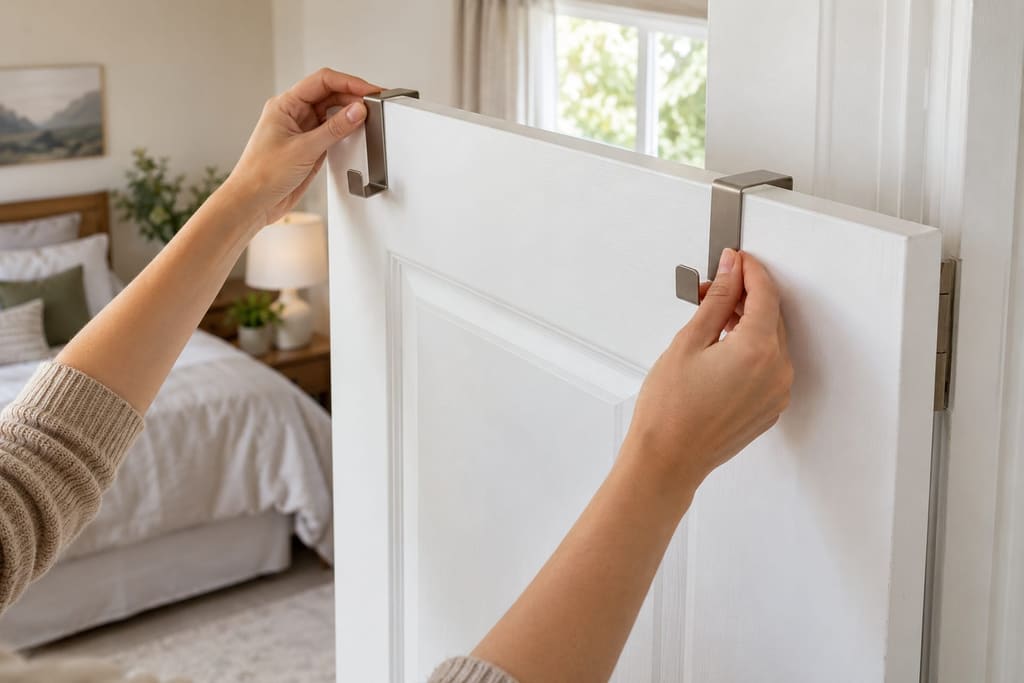
Slide the flat hooks over the top edge of the door, spaced to match the hanging points on the back of the mirror, and push them flush against the face of the door. Close the door gently to check it still latches before you hang anything on them. Then lift the mirror onto the hooks with a helper if it is tall.
-
Option B: screw on mirror clips
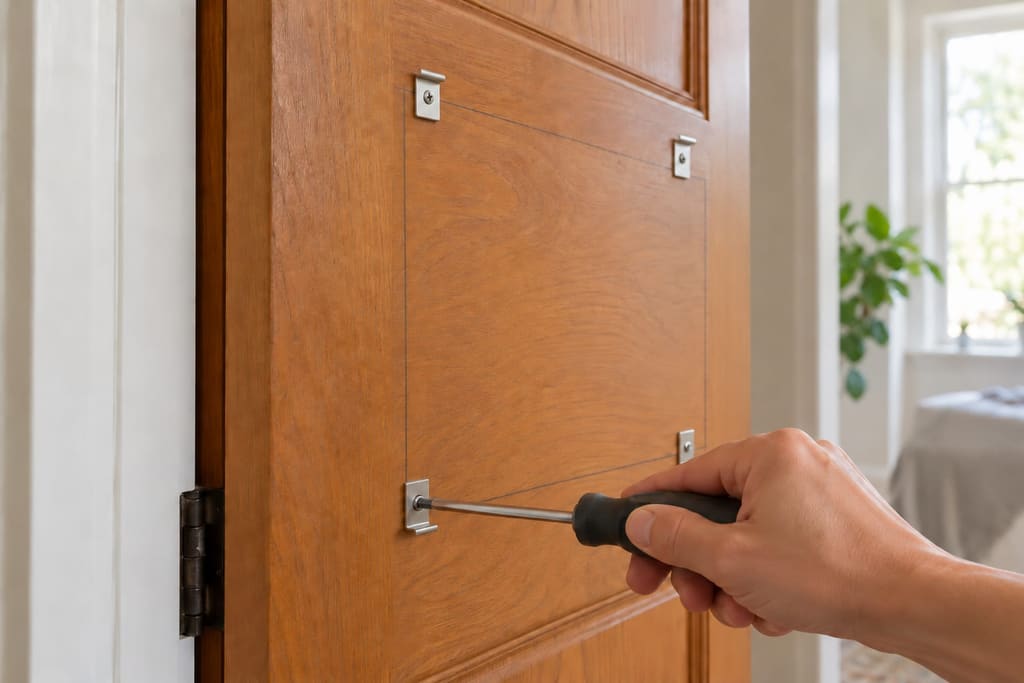
Draw the outline of the mirror on the door with a pencil and a level. Screw two fixed clips along the bottom line, then set the mirror on them and fit the top and side clips so they hold the edge without squeezing the glass. Use short screws that do not go through the door. On a hollow core door, place every clip within the solid edge frame, usually the outer inch or so, and use hollow-door anchors only for light mirrors.
-
Check the swing and the clearance
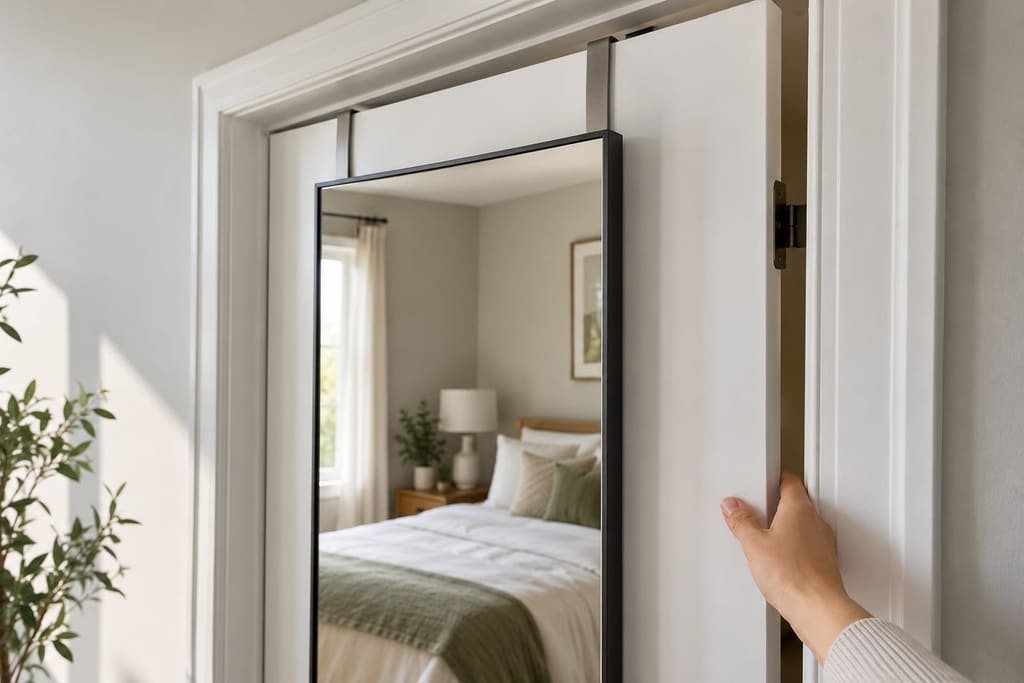
Open and close the door slowly through its whole arc. Watch the hinge edge, the top of the hooks against the frame, and the corner of the mirror near the wall. If anything touches, move the mirror in from the hinge edge or switch to thinner hooks before you load the door with daily use.
-
Stop the rattle and protect the wall
Stick small felt or rubber bumpers behind the two lower corners of a hook-on mirror so it rests against the door instead of tapping. Fit a door stop on the wall or the baseboard so the door, and the mirror on it, can never swing into the wall.
How to Hang a Mirror on a Hollow Core Door
Hollow core doors are the reason most door mirrors are sold with hooks. The two faces are thin, so a screw driven into the middle of the door has almost nothing to hold. You have three good options:
- Over-the-door hooks. No holes at all, and the weight hangs from the top edge, which is solid wood.
- Clips in the edge frame. Most hollow core doors have a strip of solid wood around the perimeter, and a block of solid wood where the handle goes. Clips screwed into those strips hold well. A thin, frameless mirror usually fits between them.
- Hollow-door anchors. These open behind the thin skin like a small toggle. They are made for light loads; I would use them only for a light mirror and always together with clips at the solid edges.
Avoid ordinary plastic wall plugs in a hollow door. They are designed for drywall and plaster and tend to spin or pull out of the thin door skin.
How to Hang a Mirror on a Door Without Nails or Damage
Over-the-door hooks are the only method that leaves no mark at all. If hooks interfere with your door, adhesive is the next option, with two cautions. First, check the weight rating printed by the adhesive maker and stay well under it, because a door moves and vibrates every time it closes. Second, adhesive strips and mirror mastic can pull paint or veneer when removed, so in a rental they are not truly damage-free.
Removable picture-hanging strips can hold a light acrylic mirror; I would not trust them alone with glass on a door. The weight difference is real: acrylic is much lighter than glass for the same size, which I explain in acrylic vs glass mirrors.
How to Hang a Long Mirror on a Door
Full-length door mirrors are tall and narrow, so the main risks are the bottom swinging and the frame flexing. Use hooks or clips at the top, plus something at the bottom: two clips, two bumpers, or a strip of adhesive on a hook-on model. Keep the bottom edge at least a few inches above the floor so it clears rugs and does not get kicked.
Closet doors
Hinged closet doors work like any other door. Bifold and sliding closet doors are thinner and lighter, so use small clips and a light mirror, and never hang anything that stops the panels from folding or passing each other.
Sources
- University of Illinois Physics, Ask the Van: Mirror, mirror, on the wall A flat mirror half your height shows you head to toe when its top sits halfway between your eyes and the top of your head.
- Plaskolite: OPTIX 99 Acrylic product data Acrylic is half the weight of glass and shatter resistant.
Keep reading: Best over-the-door mirrors · Cheap door mirrors · Acrylic vs glass mirrors · How to hang or secure a full-length mirror
The MirroRank letter
New mirror picks, sizing and lighting tips from Joan, about once a month.