
On this page
If you're trying to work out how to fix a vanity mirror light, the good news is that the cause is often simpler than it looks. A mirror that has gone dark, flickers or ignores your touch is, more often than not, a power, connection or cleaning problem rather than a dead mirror.
I've organized this guide by symptom, because that is how the problem shows up. Find yours in the table, jump to that section, and work from the easiest check to the hardest. I only give specific advice where a manufacturer or a recognized source backs it up, and where the fix means working on household wiring, I say so and tell you to call a professional. If the mirror is beyond saving, my picks for the best lighted vanity mirrors and the best LED bathroom mirrors are the next step.
Find Your Symptom
| Symptom | Likely cause | What to do |
|---|---|---|
| No light at all | No power reaching the mirror: outlet, switch, breaker, flat battery, bad adapter | Test the power source with another device, check the charge or adapter |
| Touch sensor ignores you | Dirty or damp sensor, a glitch, or a failed switch | Clean it, disconnect power briefly, then check the manual and warranty |
| Flickering | Loose connection, failing power supply or an incompatible dimmer | Reseat plugs and cables; on a hardwired mirror, call an electrician |
| Dim light | Failing power supply or components, or age | Check the adapter or driver; replace if the mirror is old |
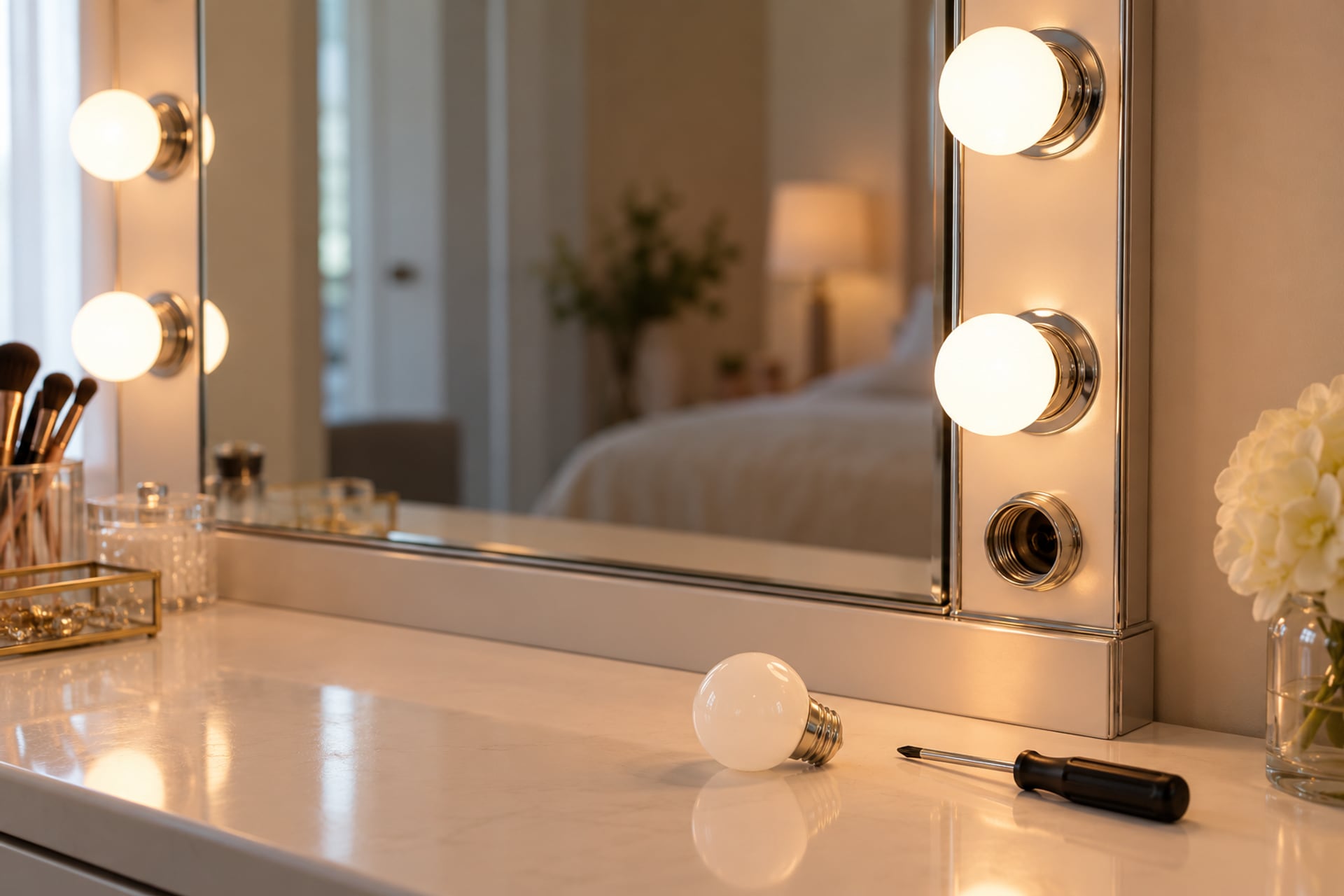
| One bulb out (Hollywood style) | Burned-out bulb | Swap in a matching bulb with the mirror unplugged |
| One zone dark (LED mirror) | Faulty LED strip or connection | Usually a warranty claim or a replacement, not a home repair |
First: What Kind of Lighted Mirror Is It?
The right fix depends on how the mirror is powered, so identify that before you do anything else. The three common types fail in different ways.
Plug-In, USB or Battery Mirrors
These are the small tabletop and compact mirrors. Power comes from a wall adapter, a USB cable or a rechargeable battery, so the failure points are the cable, the adapter, the charge and the switch. They are low voltage or self-contained, which makes them the safest to troubleshoot yourself. My guide to the best lighted magnifying makeup mirrors covers this type.
Hardwired LED Bathroom Mirrors
These are wired into the house circuit, usually through a wall switch or a junction box behind the mirror. Inside, the mains power runs through a driver (the transformer) that feeds the LED strips. You can do the outside checks yourself: the switch, the breaker and cleaning the controls. Anything behind the mirror is for a licensed electrician. If you're still deciding on one, see my LED bathroom mirror installation guide.
Hollywood Mirrors With Bulbs
These are the classic frames with a row of round bulbs. They are either plugged in or hardwired, and the bulbs are usually the first thing to check. Many modern Hollywood mirrors use LED bulbs, so the same lifespan notes below apply.
Mirror Lights Not Working at All
When nothing lights up, the cause is almost always upstream of the mirror. Work from the wall inwards.
Check the Power: Outlet, Switch, Breaker and GFCI
Plug a lamp or a phone charger into the same outlet. If that doesn't work either, the problem is the outlet, and bathroom outlets are often protected by a GFCI, the outlet with the Test and Reset buttons. Press Reset once. If the outlet still has no power, check the breaker panel. Warmly Yours, which makes heated floors and lighted mirrors, begins its no-light troubleshooting guide at the switch that controls the mirror and tells you that if power isn't reaching it, to "inspect the breaker, consult with electrician." I'd follow that: resetting a GFCI or flipping a breaker you can see is fine, but chasing a missing circuit through the walls is not a DIY job.
On a hardwired mirror, also confirm the wall switch is on. It sounds obvious, but it's a common reason for a "dead" mirror after cleaning or renovation.
Battery and Charging Problems
On a cordless or rechargeable mirror, charge it fully with the cable that came with it, then try again. Try a different cable and a different USB port or wall adapter, because cables fail far more often than mirrors do. If the mirror takes a charge but won't light, or won't take a charge at all, the battery or the charging circuit has probably failed, and that belongs with the manufacturer under warranty.
Adapter Problems
For a plug-in mirror, check that the adapter's plug is pushed fully into the mirror and the wall, and that the cable isn't kinked or pinched at either end. Use only the adapter that shipped with the mirror, or an exact replacement from the manufacturer. A different adapter that fits the plug can deliver the wrong voltage and damage the lights.
Touch Sensor Not Responding
A touch sensor mirror that ignores your finger is one of the most common complaints, and the fix is usually small.
Humidity and Cleaning
Bathroom steam, toothpaste splashes and the oils from your fingers can all interfere with a touch control. Wipe the touch area with a dry or very slightly damp soft cloth and dry it, using the cleaning approach in my guide to cleaning a mirror without streaks. Spray cleaner onto the cloth, not the mirror, so liquid doesn't run behind the glass. Wait a few minutes after a hot shower before you test it.
Reset by Cutting the Power
Many electronic mirrors behave better after a short power cycle. On a plug-in or USB mirror, unplug it, wait a minute and reconnect. On a hardwired mirror, switch it off at the wall switch or breaker for a minute and switch it back on. Check the manual for a model-specific reset, because I haven't found one that works across brands and I won't pretend there is a universal button combination.
A Faulty Sensor or Switch
If cleaning and a power cycle change nothing, the touch sensor or the control board has probably failed. That is a part the manufacturer replaces, not something to solder at home. Contact the seller with your order number and a photo or short video of the fault, and mention the warranty.
Flickering or Dim Lights
Future Light, a lighting supplier, lists three causes for a flickering LED mirror: "faulty wiring, incompatible dimmer switches, or failing LED components." That is a useful frame, and I'll take them in order of how easy they are to check.
A Loose Connection
On a plug-in or USB mirror, push both ends of the cable in firmly and check that the plug isn't bent. If the flicker comes and goes when you move the cable, the cable or the socket is the cause. On a hardwired mirror, a loose connection between the driver and the mirror is a known cause of flickering, but reaching it means opening the mounting area, which is electrician territory.
A Failing Driver or Power Supply
LED strips run on low voltage, so a hardwired mirror has a driver that converts the house current into the right voltage and current for the strips. Warmly Yours' troubleshooting guide checks for 12V DC output at the driver, and says that if it is missing after the connections are checked, the driver or transformer should be replaced. A driver that is failing can cause flicker or dimming before it fails completely. Replacing one means working on mains wiring, so I'd leave it to a licensed electrician or to the manufacturer.
A Dimmer That Doesn't Suit LEDs
If the mirror is on a wall dimmer, an incompatible dimmer can cause flicker. Check the mirror's manual for what it supports. If you're not sure, try the mirror with the dimmer bypassed or set to full, or ask the manufacturer which dimmer type to use, and have an electrician swap the wall control if needed.
One Section or Bulb Out
When most of the mirror works and one spot doesn't, the problem is local. How you fix it depends on the build.
Hollywood Bulbs: Swap the Bulb
On a Hollywood-style mirror, a single dark bulb is almost always a burned-out bulb. Unplug the mirror, let it cool, and swap in a bulb that matches the original in base type and wattage rating. The manual or the label next to the socket tells you which. If a new bulb in that socket still doesn't light, the socket or its wiring is the issue, and that is a warranty or replacement matter.
LED Strip Sections: Usually Not a Separate Fix
Most integrated LED mirrors have the strips built in behind the glass, and they are not designed to be replaced one section at a time. Warmly Yours advises that if the wires feeding the LED strips are damaged, the fix is to replace the LED strips and wire assembly. That is a manufacturer repair. A dark zone on an otherwise working mirror usually means a defective strip or connection, so contact the seller before you consider cutting into the mirror.
Do LED Mirror Lights Burn Out?
Not in the way an old filament bulb does. ENERGY STAR states that LEDs "typically do not burn out or fail." Instead, they go through lumen depreciation, a slow dimming over time, and an LED's rated lifetime is a prediction of when its light output falls by 30 percent. Heat speeds that fade up, which is why a hot, steamy bathroom and poor ventilation behind a mirror don't help.
So when an LED mirror stops working, the LEDs themselves are rarely the first suspect. The electronics, the driver and the connections tend to go first. Future Light says these mirrors generally last for tens of thousands of hours depending on usage and build quality, which is a manufacturer's claim rather than a guarantee. A mirror that has slowly dimmed over years is simply aging. A mirror that died or flickers suddenly is more likely a power or connection fault, and those are worth diagnosing using the sections above.
Repair, Warranty or Replace?
Decide before you pick up a screwdriver, because the answer protects you.
Check the Warranty First
Opening a sealed mirror, cutting into the backing or touching the wiring can void the warranty. If the mirror is new enough to be covered, take a photo of the fault, note the symptoms and contact the seller first. A defective strip, sensor or driver is exactly what a warranty is for.
When Replacing Makes Sense
If the mirror is out of warranty, the fault is in the driver or strips, and a repair would cost a large share of a new mirror, replacing is usually the better deal. A cheap plug-in mirror is rarely worth repairing at all. When you shop, compare the options in my lighted vanity mirror picks, and for makeup lighting specifically, see best lighting for makeup.
Sources
- Warmly Yours: LED Mirror, No LED (support article) Check power at the switch and breaker and consult an electrician if it is missing; check the junction box, driver input and 12V DC output; replace the driver or the LED strip assembly if faulty.
- Future Light: Lighted Bathroom Mirrors, Installation, Maintenance and Customization Check the mirror is plugged in and powered; flickering can indicate faulty wiring, incompatible dimmers or failing components; lifespan of tens of thousands of hours; consult a licensed electrician for complex setup.
- ENERGY STAR: Learn About LED Lighting LEDs typically do not burn out; they dim slowly (lumen depreciation); lifetime is the point at which output falls by 30 percent; heat speeds up degradation.
Keep reading: Best lighted vanity mirrors · Best LED bathroom mirrors · Best lighted magnifying makeup mirrors · How to install an LED bathroom mirror · Best lighting for makeup
The MirroRank letter
New mirror picks, sizing and lighting tips from Joan, about once a month.