Mirror guide
Handprint on the Mirror After a Shower: What It Means
 By Joan Bardot · Updated 5 sources cited
As an Amazon Associate I earn from qualifying purchases. How I choose products.

On this page
A handprint on the mirror after a shower can stop you in your tracks, especially when you don't remember touching the glass. The explanation is ordinary and a little bit satisfying: skin leaves an invisible film of oil wherever it touches, and steam makes that film visible. The print you see may have been there for days or weeks, waiting for the next hot shower.
Below I explain why the print appears, why it can look like a small hand or a strange shape, how to clean it off properly (without the vinegar trick that damages mirrors), and how to stop the mirror fogging in the first place. If fog is the real annoyance, my picks for the best LED bathroom mirrors include models with built-in defoggers, and the best shaving mirrors cover fogless mirrors for inside the shower.
Why a Handprint Appears on the Mirror After a Shower
Two pieces of physics combine here: why mirrors fog at all, and why oil changes the way they fog.
Why Bathroom Mirrors Fog
Hot shower water fills the air with water vapor. The dew point is the temperature at which air holding that much moisture becomes saturated, and when the moist air touches a surface colder than its dew point, the vapor condenses on it as liquid water. Your mirror is one of the coldest surfaces in the room, so it collects a layer of tiny droplets. Those droplets scatter light, which is what makes the glass look white and foggy.
Why Skin Oil Shows Up in the Fog
Clean glass is hydrophilic: water likes it. Skin oil is hydrophobic: water avoids it. The Naked Scientists, the science podcast, explain the effect on fogging: on water-loving glass, droplets start easily, so the fog forms as countless tiny droplets; on a greasy patch, droplets form with more difficulty and grow into a few larger ones, which look transparent. So the oily print shows up as a clearer or differently textured shape in the middle of the white fog.
Why It Can Be Weeks Old
The oil film doesn't evaporate like water. If nobody cleans that part of the mirror properly, it stays put, invisible, and shows itself every time the glass fogs. That is why a print can appear long after anyone touched the mirror, and why it reappears in the same place shower after shower until it is cleaned off.
What a Handprint on the Mirror Can Mean
Searches for this often ask about meaning, and I understand why: a handprint you can't explain is unsettling. Here are the everyday explanations I would check first.
| What you see | Most likely cause | What to do |
|---|---|---|
| A small handprint at child height | A child touched the mirror days or weeks ago | Clean with warm water and a microfiber cloth, then buff dry |
| An adult handprint or fingertips near the edge | Someone steadied themselves or adjusted the mirror | Same: clean the whole mirror, not just the print |
| Swirls, arcs or a smeared "hand" | A cloth or towel spread oil in a pattern | Clean with a fresh cloth and buff with a second, dry one |
| Letters or a word | Someone wrote on the fogged glass with a finger | Clean it off; it will keep reappearing until you do |
| A print that comes back after cleaning | The cleaning spread the oil instead of removing it | Rinse the cloth often; finish with a dry buff |
| Clear patches where the fog won't form | Residue from soap, hairspray or a past anti-fog treatment | Clean the whole mirror evenly, top to bottom |
When It Still Feels Strange
If the shape still bothers you, clean the mirror thoroughly and fog it again with a hot shower. If the print was oil, it will be gone. If something new appears later, it means someone touched the glass in between: it's worth asking the people you live with before reaching for any other explanation.
The "Writing on the Mirror" Trick
The same physics is behind the old trick of writing a message on a mirror with a fingertip so it appears only when the bathroom steams up. It works for the same reason a stray handprint does, and it disappears the same way: with a proper clean.
How to Clean a Handprint Off a Mirror for Good
The National Glass Association's mirror care bulletin, Proper Procedures for Cleaning Flat Glass Mirrors, sets out what mirror manufacturers recommend, and it is the routine I follow. My full guide on how to clean a mirror without streaks goes into more detail.
Removing an oily handprint
-
Start with warm water and a microfiber cloth
The NGA calls clean, warm water with a soft, lint-free cloth "the very best and safest cleaner for a mirror". Wring the cloth out well first.
-
Put any cleaner on the cloth, not the glass
For a greasy print that water alone doesn't shift, apply a little mild glass cleaner to the cloth. The NGA advises against spraying cleaners directly on a mirror, so liquid doesn't run into the edges, and against cleaners containing ammonia or vinegar.
-
Wipe the whole mirror, not just the print
Work top to bottom across the whole glass, rinsing the cloth often. Cleaning only the print leaves a clean patch that fogs differently from the rest.
-
Buff dry and dry the edges
Finish with a second, dry microfiber cloth. The NGA's last step is to make sure all joints and edges are dry, because moisture at the edges causes "black edge", the dark corrosion of the silver backing.
-
Test it with steam
After your next shower, look at the fog. An even white film means the oil is gone. If the print is still there, repeat with fresh cloths.
Soap Film and Hairspray
Bathroom mirrors also collect soap spray, toothpaste flecks and hairspray, which make patches fog unevenly, just like oil. For stubborn surface marks, the NGA recommends 0000 oil-free steel wool rather than solvents, because solvents can attack the edges and backing. Use it gently and only on the glass face, away from the edges.
Why Not Vinegar?
Vinegar and water is the most repeated mirror tip online, but the NGA bulletin says not to use mirror cleaners containing ammonia or vinegar, and not to use acid or alkali cleaners at all, because either can attack the front surface, the edges and the backing. On a bathroom mirror that already lives with steam, that is exactly the damage you don't want; my guide to mirror desilvering shows what it looks like.
How to Stop a Bathroom Mirror Fogging
A mirror that doesn't fog can't show a handprint. These are the options, from free to fitted.
Ventilation: the Free Fix
ENERGY STAR's advice is to control bathroom humidity by running the ventilating fan "during and 15 minutes after showers and baths". The EPA's remodeling guidance adds that bathroom exhaust should go directly outside, not into the attic, and cites ASHRAE's recommendation of 25 cubic feet per minute for a fan that runs continuously, or 50 cfm for one switched on and off as needed. Cracking the door open during the shower helps too, because it lets the moist air out.
Anti-Fog Treatments
Anti-fog sprays and wipes leave a thin coating that changes how condensation forms on the glass, so it stays see-through instead of turning white. They need reapplying, and some leave a slight haze if overapplied. Apply to the glass face only and buff gently.
Heated Pads and LED Mirrors With Defoggers
A heating pad on the back of the mirror keeps the glass above the dew point, so vapor can't condense on it. Many lighted bathroom mirrors build this in as a defogger; my guide to the best LED bathroom mirrors covers models with it.
A Fogless Mirror for the Shower
If you shave or do your brows in the shower, a fogless shower mirror is the simplest answer. My best shaving mirrors guide compares the main types.
| Option | How it works | Effort | Best for |
|---|---|---|---|
| Fan during and after | Removes moist air | None | Every bathroom |
| Door ajar | Lets steam escape | None | Small bathrooms without a good fan |
| Anti-fog spray | Film spreads condensation evenly | Reapply regularly | Renters, quick fix |
| Heated pad or defogger | Keeps the glass above the dew point | Fitted once, needs power | Remodels and new mirrors |
| Fogless shower mirror | Designed to resist fog inside the shower | Hang it once | Shaving in the shower |
Fog and Fingerprint Kit
Three inexpensive things that deal with prints and fog.
-
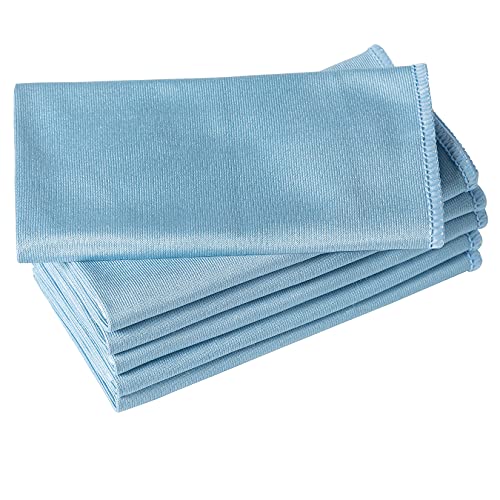
1Microfiber cloths
Puomue Microfiber Glass Cleaning Cloths, 6 Pack
Lint-free 16 x 16 inch cloths: one damp to clean, one dry to buff, and spares so you never spread oil with a dirty cloth.
-
2Anti-fog spray
MIRRORVANA Anti Fog Spray, 2 Bottles
An anti-fog spray sold for bathroom and shower mirrors; apply to clean glass and buff to keep the mirror clear after a shower.
-
3Fogless shower mirror
ToiletTree Fogless Shower Mirror
My pick from the shaving mirror guide for anyone who wants a mirror inside the shower that stays usable in the steam.


Sources
- The Naked Scientists: Why can't I get a car window to fog up twice? Grease is hydrophobic and glass hydrophilic; droplets form easily on clean glass and with difficulty on greasy patches, where they grow larger and look transparent.
- Wikipedia: Dew point Air touching a surface colder than its dew point deposits liquid water on it.
- National Glass Association: Proper Procedures for Cleaning Flat Glass Mirrors (FB06-05, 2019) Warm water and a lint-free cloth, cleaner on the cloth, no ammonia, vinegar, acid or alkali, 0000 oil-free steel wool instead of solvents, dry edges to avoid black edge.
- ENERGY STAR: Low- to No-Cost Tips for Saving Energy at Home Run the bathroom ventilating fan during and 15 minutes after showers and baths.
- US EPA: Remodeling Your Home and Indoor Air Quality Bathroom exhaust of 25 cfm continuous or 50 cfm intermittent (ASHRAE), vented directly outside.
Keep reading: How to clean a mirror without streaks · Best LED bathroom mirrors · Best shaving mirrors · Is that mirror two-way?
The MirroRank letter
New mirror picks, sizing and lighting tips from Joan, about once a month.