Full-length and studio
Best Dance Studio Mirrors
 By Joan Bardot · Updated
As an Amazon Associate I earn from qualifying purchases. How I choose products.
On this page
A dancer uses a mirror differently from anyone else. You watch lines, not faces, from six or ten feet away, while you move, and a mirror that bends the image or breaks the wall into narrow strips teaches you the wrong shapes. The best dance studio mirrors are big, flat, frameless panels that butt together into one wall, mounted firmly enough that nobody worries about them during a jump.
This guide covers dance mirrors for home studios and small schools: frameless wall panels in two- and three-packs, and two rolling dance mirrors on wheels for rooms where you can't drill. I've included a panel count for 8, 10 and 12 foot walls, because that's the first thing to work out before you buy. If you're working to a tight budget or renting, my cheap dance mirrors for home practice covers portable and no-drill options.
My top picks
- Editor's choice
Best Overall
pertetey 65x24 Wall Mirror, 3-Pack
- Premium
- Wall panels, 3
- 65 x 24 in each
- 72 in wide, 65 in tall
Keep in mind: Two people needed for each tall panel
Check price on Amazon -
Best Full Studio Wall
InfiniGlass 60x40 Wall Mirror, 3-Pack
- Premium
- Wall panels, 3
- 60 x 40 in each
Keep in mind: Large, heavy panels: a two-person job each
Check price on Amazon -
Best Portable
brisafe Tri-Fold NanoMirror 71x71
- Premium
- Tri-fold on wheels
- 71 x 71 in open
Keep in mind: Film is less crisp than glass and scratches more easily
Check price on Amazon
Dance Studio Mirrors Compared
Five wall kits and one rolling tri-fold. Panel sizes are as the maker lists them; coverage assumes the panels stand upright side by side, which is how a dance wall uses them.
| Mirror | pertetey 65x24 (3) Editor's Choice | InfiniGlass 60x40 (3) | brisafe Tri-Fold | CrossROBBIN 48x32 (2) | Delma 54x30 (2) | Honyee 48x24 (3) |
|---|---|---|---|---|---|---|
| Mirror |  |  | 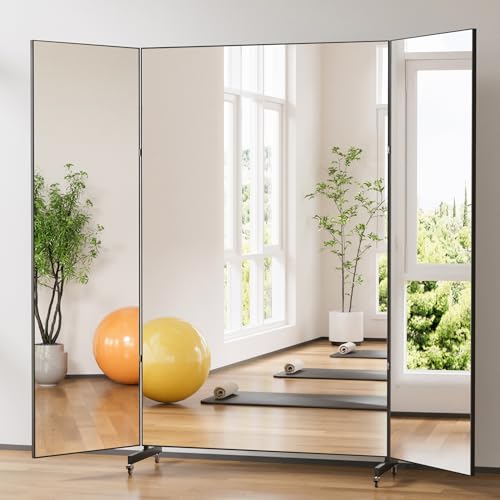 |  |  |  |
| Type | Wall panels, 3 | Wall panels, 3 | Tri-fold on wheels | Wall panels, 2 | Wall panels, 2 | Wall panels, 3 |
| Size | 65 x 24 in each | 60 x 40 in each | 71 x 71 in open | 47.2 x 31.5 in each | 54 x 30 in each | 48 x 24 in each |
| Coverage upright | 72 in wide, 65 in tall | 120 in wide, 60 in tall | 71 in wide | 63 in wide, 47 in tall | 60 in wide, 54 in tall | 72 in wide, 48 in tall |
| Glass | HD tempered glass | HD tempered glass | Nano film, no glass | Silvered, 1/5 in thick | Float glass, frosted edges | Silver-backed, safety membrane |
| Best for | A home studio wall | A full 10 ft wall | No-drill, shared rooms | Humid rooms, studios | Fewer seams, 2 panels | Matching panels for less |
| Price tier | $$$ | $$$ | $$$ | $$ | $$ | $$ |
| Buy | Check price on Amazon | Check price on Amazon | Check price on Amazon | Check price on Amazon | Check price on Amazon | Check price on Amazon |
Editor's Choice
pertetey 65x24 (3)
- Best for
- A home studio wall
Show specifications
- Type
- Wall panels, 3
- Size
- 65 x 24 in each
- Coverage upright
- 72 in wide, 65 in tall
- Glass
- HD tempered glass
- Price tier
- $$$
InfiniGlass 60x40 (3)
- Best for
- A full 10 ft wall
Show specifications
- Type
- Wall panels, 3
- Size
- 60 x 40 in each
- Coverage upright
- 120 in wide, 60 in tall
- Glass
- HD tempered glass
- Price tier
- $$$
brisafe Tri-Fold
- Best for
- No-drill, shared rooms
Show specifications
- Type
- Tri-fold on wheels
- Size
- 71 x 71 in open
- Coverage upright
- 71 in wide
- Glass
- Nano film, no glass
- Price tier
- $$$
CrossROBBIN 48x32 (2)
- Best for
- Humid rooms, studios
Show specifications
- Type
- Wall panels, 2
- Size
- 47.2 x 31.5 in each
- Coverage upright
- 63 in wide, 47 in tall
- Glass
- Silvered, 1/5 in thick
- Price tier
- $$
Delma 54x30 (2)
- Best for
- Fewer seams, 2 panels
Show specifications
- Type
- Wall panels, 2
- Size
- 54 x 30 in each
- Coverage upright
- 60 in wide, 54 in tall
- Glass
- Float glass, frosted edges
- Price tier
- $$
Honyee 48x24 (3)
- Best for
- Matching panels for less
Show specifications
- Type
- Wall panels, 3
- Size
- 48 x 24 in each
- Coverage upright
- 72 in wide, 48 in tall
- Glass
- Silver-backed, safety membrane
- Price tier
- $$
Dance Studio Mirror Reviews
I judged every mirror here the way a dancer would: how flat the glass stays, how much of you it shows from across the room, and how safe it is when someone stumbles into it.
Editor's choice · Best Overall
pertetey 65x24 Wall Mirror, 3-Pack
- Premium
- Type Wall panels, 3
- Size 65 x 24 in each
- Coverage upright 72 in wide, 65 in tall
- Glass HD tempered glass
The pertetey three-pack is the dance mirror I'd put in a home studio first, and the reason is height. Each frameless panel is 65 inches tall and 24 wide, so three stood side by side give you a 6 foot wide wall of glass that shows far more above your head than the usual 48 inch panel. Arms in fifth and a relevé stay in the glass far more often instead of disappearing off the top.
The glass is HD tempered, and tall, frameless glass that stays flat is what a dancer watching lines from across the room needs. pertetey gives two ways to mount it: adhesive for smooth, clean walls, or the screws and anchors in the box. pertetey itself recommends screws on textured, painted or humid walls, and on a dance wall I'd use them everywhere.
Three matching panels from one box means the tint and thickness match across the wall, and the frameless edges butt together with seams you stop noticing. The maker backs the set with five years of service and replaces panels that arrive damaged. For a serious home studio, this is the best balance of height, safety and coverage on the page.
What I like
- 65 inch panels show far more above your head
- HD tempered glass, frameless
- Screws and anchors, plus adhesive for smooth walls
- Three matched panels cover 6 feet
Keep in mind
- Two people needed for each tall panel
- Six feet of width is one or two dancers, not a class
Best Full Studio Wall
InfiniGlass 60x40 Wall Mirror, 3-Pack
- Premium
- Type Wall panels, 3
- Size 60 x 40 in each
- Coverage upright 120 in wide, 60 in tall
- Glass HD tempered glass
If you want a proper studio wall in one order, the InfiniGlass is it. Each frameless panel is 60 by 40 inches of HD tempered glass, which InfiniGlass describes as shatterproof and distortion-free, and three of them stood upright cover 120 inches: a full 10 foot wall with only two seams.
Those wide panels are what make it special. On a 48 by 24 kit you'd have five seams across the same wall; here a dancer travels across the room and stays in one piece of glass for most of the way. The brackets are in the box. InfiniGlass ships them in shock-proof packaging, which you'll be glad of with glass this size.
Plan the install properly: each panel is a lot of glass to lift and hold flat, so book a helper and find the studs first. And if you have a ceiling height to use, the pertetey panels give you five more inches of height.
What I like
- Covers a 10 foot wall in one box
- Big 40 inch wide panels, very few seams
- HD tempered, shatterproof glass
- Brackets included
Keep in mind
- Large, heavy panels: a two-person job each
- 60 inches tall, shorter than the pertetey
Best Portable
brisafe Tri-Fold NanoMirror 71x71
- Premium
- Type Tri-fold on wheels
- Size 71 x 71 in open
- Coverage upright 71 in wide
- Glass Nano film, no glass
The brisafe isn't glass. It's a 0.04mm reflective film over a reinforced backing, which brisafe says weighs a fifth of a glass mirror and can't shatter. Opened out, the three panels form a 71 inch mirror, and it folds flat against a wall or door when the room has to be a living room again.
brisafe lists tool-free assembly in about five minutes and a weighted base for stability on carpet, wood or tile. It rolls on 360 degree casters, and the tilt adjusts for a better angle. The reflection is good enough for practice and choreography, though a film never looks quite as crisp as good glass, and it marks if you lean sharp objects against it.
It comes in black or white. For a family room, a rented apartment or a class of young children, nothing else here is as safe or as easy to move.
What I like
- Can't shatter: the safest choice around small children
- 71 inches wide and tall open, folds flat
- Rolls on swivel casters, tool-free assembly
- Adjustable tilt
Keep in mind
- Film is less crisp than glass and scratches more easily

If you want a rolling dance mirror in real glass, this is the one I'd look at. AISUNDY lists it as tempered glass with an explosion-proof membrane in a thin stainless steel frame, about 65 inches tall and 23 wide, on four omni-directional wheels. The same listing names dance studios and home gyms as uses, and it weighs about 21 pounds, which is light enough to push across a room alone.
It tilts too: you loosen the side screws with the supplied wrench, set the angle and tighten them again. A slight tilt helps when you are practicing low or sitting on the floor to stretch.
Two limits. It's a single mirror, so it shows one dancer's working space, and AISUNDY doesn't mention locking wheels. Before you dance, wedge the base or put it on a non-slip mat; my guide to stopping floor mirrors from sliding covers the options.
What I like
- Tempered glass with an explosion-proof membrane
- Four omni-directional wheels
- Tilts to the angle you set
- About 21 pounds, light for a glass mirror
Keep in mind
- About 23 inches wide: one dancer, not a class
- The listing doesn't mention wheel locks
Best Commercial Grade
CrossROBBIN 48x32 Activity Mirror, 2-Pack
- Mid-range
- Type Wall panels, 2
- Size 47.2 x 31.5 in each
- Coverage upright 63 in wide, 47 in tall
- Glass Silvered, 1/5 in thick
The CrossROBBIN mirrors are sold for home gyms and commercial spaces, and the specs read like it. Each panel is about 47.2 by 31.5 inches of silvered glass, 1/5 inch thick, and two stood upright give you a 63 inch wide practice wall. Thicker glass flexes less than thin panels, which is what keeps a reflection flat across a wide sheet.
The detail I value for a studio is the tarnish-resistant coating, which CrossROBBIN makes for high-humidity areas. A room full of dancers gets warm and damp, and that's what eats the silver at the edges of cheaper mirrors over time. The hanging hardware is in the box.
The listing doesn't mention tempering or a safety film, so treat these as ordinary mirror glass: mount them firmly into studs and keep a clear zone in front. If young children will use the room, add a safety film to the back before you hang them.
What I like
- Thick 1/5 inch silvered glass
- Tarnish-resistant coating for humid rooms
- 32 inch wide panels, fewer seams
- Hanging hardware included
Keep in mind
- No tempering or safety film stated
- Just under 48 inches tall
Best 2-Panel Set
Delma 54x30 Wall Mirror, 2-Pack
- Mid-range
- Type Wall panels, 2
- Size 54 x 30 in each
- Coverage upright 60 in wide, 54 in tall
- Glass Float glass, frosted edges
Two panels, one seam, a 5 foot wide mirror: the Delma set is the simplest way to a practice wall that looks like a studio. Each frameless panel is about 54 by 30 inches of HD float glass with frosted edges, and Delma sells the set as tempered and shatterproof.
What sets it apart is the box. You get metal frame bars, tapes, screws and anchors, so the bottom support is taken care of, and Delma says the panels suit tile, brick, wood and painted walls. The bars give both panels a common bottom line, which makes it easier to get them level with each other.
It's the kit I'd suggest for a single dancer or a small corner studio. If you need a whole wall, a three-pack covers more for the money.
What I like
- 30 inch panels: a 5 foot wall with one seam
- Frosted edges for safer handling
- Complete kit: frame bars, tape, screws, anchors
- Suits tile, brick, wood and painted walls
Keep in mind
- Two panels cover one dancer's working space
- 54 inches tall, less than the pertetey
Best Budget
Honyee 48x24 Wall Mirror, 3-Pack
- Mid-range
- Type Wall panels, 3
- Size 48 x 24 in each
- Coverage upright 72 in wide, 48 in tall
- Glass Silver-backed, safety membrane
48 by 24 inches is the most common panel size for home dance and gym walls, and this Honyee kit gives you three of them, 72 inches of mirror side by side when stood upright. It scales well: two kits cover a 12 foot wall with six matching panels.
The listing describes float glass with a silver backing that the maker says improves durability in humid rooms, which counts in a studio where people sweat, plus an explosion-proof membrane over the glass and hand-polished edges. The listing mentions both annealed and tempered glass, so I treat the membrane as the safety feature that matters. The hardware is included, and Honyee says a panel goes up in about 20 minutes.
It's the way to cover a whole wall without stepping up to the premium kits, as long as you accept shorter glass.
What I like
- Three panels, the easiest kit to scale
- Silver backing for humid rooms
- Safety membrane and hand-polished edges
Keep in mind
- The listing isn't clear whether the glass is tempered
- 48 inches tall: less above your head
How I Chose These Dance Mirrors
A dance mirror fails in different ways from a vanity mirror: it has to stay flat across a big area, look the same from ten feet as from two, and be safe when someone falls against it. These are the things I judged every mirror on:
- Safety layer first. Tempered glass, a safety membrane or film, or glassless film. Where a listing doesn't state one, I say so in the review.
- Frameless panels for walls, so they butt together without a frame line every two feet.
- Panel size. Bigger panels mean fewer seams and taller glass shows more of the movement; I favored 54 inches tall or more.
- Hardware in the box, with bars or brackets rather than adhesive alone.
- A no-drill option for renters and shared rooms.
How Many Mirror Panels Does Your Wall Need?
Divide the wall width by the panel width, and decide where the seams go before you order. Panels stand upright on a dance wall, so a 48 by 24 inch panel covers 24 inches of width and a 60 by 40 inch panel covers 40. A seam right in front of the center of the room is the one you'll notice, so where you can, use an odd number of panels and center the middle one.
Buying for the count
Buy all the panels from the same listing so the glass tone, thickness and edge finish match. For a 10 foot wall of 24 inch wide panels you need five: two Honyee or two pertetey 3-packs give you six, with one spare for a breakage. One InfiniGlass 3-pack covers the same 10 feet exactly. Wider panels change the arithmetic, so redo it with their widths: two CrossROBBIN panels cover about 63 inches, two Delma panels 60.
Mounting height
A flat mirror only needs to be half your height to show you head to toe, if it hangs at the right height. With 48 inch panels, a bottom edge about 20 inches off the floor puts the top at 68 inches, which covers dancers from about 4 feet to 5 foot 10 standing still. Taller glass gives you more room: a 65 inch pertetey panel with its bottom edge 16 inches up reaches 81 inches, enough for almost any adult. Raise the bottom edge if a baseboard or heater is in the way, and lower it for a class of small children.
Glass vs Acrylic Dance Mirrors
Glass is the standard for a dance wall because it stays perfectly flat, so the reflection doesn't wobble as you move along it. Acrylic is lighter and won't shatter, but a large acrylic sheet flexes, and a flexing mirror bends your line like a funhouse mirror, which is the last thing a dancer needs. Film mirrors like the brisafe sit in between: light, unbreakable, and flat as long as the frame holds them taut.
My rule: glass with a safety layer on a permanent wall; acrylic or film where children are young, where the mirror moves, or where it hangs on a door. My acrylic vs glass mirror guide goes deeper on clarity, weight and cost.
Rolling Dance Mirrors on Wheels
Dance studio mirrors on wheels solve one problem: a room you can't drill into. A rolling mirror stands on its own base, rolls to where the class is and rolls away afterward. Two on this page do it, the brisafe tri-fold and the AISUNDY arched mirror, and they work in opposite ways.
When a rolling mirror beats wall panels
Choose wheels when the wall isn't yours to drill: a rental, a church hall, a school gym or a living room that doubles as the studio. They also win in a multipurpose room where the mirror has to be out of sight for the next class, and when you aren't sure where the mirror wall should go. Wall panels still win for width and permanence. A rolling mirror shows one dancer or a small group, so for a class, buy panels or put two rolling mirrors side by side. If you're renting and watching the budget, my cheap dance mirrors page compares the no-drill options.
Glassless vs glass on a frame
A glassless mirror on wheels, like the brisafe, uses a reflective film over a reinforced backing. brisafe says it weighs a fifth of a glass mirror and can't shatter, so it's the pick for lightweight portable dance mirrors around children. The cost is crispness: film never reads quite as flat as glass. A glass mirror on a rolling frame, like the AISUNDY, gives the sharper image, and its listing describes tempered glass with a membrane that holds the pieces if it breaks. It's heavier and more rigid, but still easy to push. My acrylic vs glass guide explains the trade-off in more depth.
Casters and locks
The wheels are what make it usable, and also the risk. A mirror that rolls when you push off from it is a hazard, so lock the casters before every class. The brisafe lists swivel casters and a weighted base; the AISUNDY lists four omni-directional wheels. Neither listing mentions locks, so check the wheels when your mirror arrives. If they don't lock, use a rubber wedge or a non-slip mat under the base, and keep a clear zone in front of the glass.
Storage and doorways
Measure before you buy, not after. Check the width of every door and hallway the mirror has to pass through, and the space where it will live. A tri-fold folds flat against a wall or door, so it stores in a smaller footprint than its open width. A single arched mirror stays the same size all the time, so it needs a corner where it can lean back at a slight tilt. Either way, park it away from heaters and out of direct sun, and don't leave it in a path where someone can back into it.
For more on mirrors chosen for a workout room, see my home gym mirrors.
How to Mount Dance Mirrors
Find a flat wall and the studs
Frameless panels show every bump in the wall. Check the wall with a long level or a straightedge, and pick the flattest one. Mark the studs before you plan the layout; bars and brackets should catch studs wherever they can, with anchors rated well above the panel weight elsewhere. My guide to hanging a heavy mirror covers anchors, Z-bars and cleats.
Bars and brackets, not just tape
A bottom bar or J-channel carries the weight, and clips or a top bar stop the panel tipping forward. Some kits offer adhesive as well; on a dance wall, where feet and bodies hit it, I want mechanical fixings.
Two people per panel
Mirror glass 4mm thick weighs about 2 pounds per square foot, so a 60 by 40 inch panel of that thickness would be roughly 34 pounds of glass that is awkward to hold flat. Carry panels on edge, never flat, and have one person hold while the other fixes.
Leave a hair's gap
Panels shouldn't grind against each other. Leave a very small, even gap at each seam so the glass can move with the wall through the seasons.
Ballet Barres and Large Studio Glass
Two things you won't find among the products on this page. Ballet barres, wall-mounted or freestanding, come from dance studio suppliers, along with the brackets that hold them. Floor-to-ceiling studio glass, the 6 or 8 foot tall sheets you see in dance schools, is usually cut and installed by a local glass company or bought through the same studio suppliers, because it's too big to ship as a parcel.
If you're adding a wall-mounted barre, plan it before the mirrors. Its brackets need solid fixing into studs, and they either go through the gaps between panels or the mirror layout has to leave room for them. A freestanding barre needs no fixing at all, which suits renters and rooms with a mirror wall already in place.
For strength and conditioning in the same room, my home gym mirrors list covers panels chosen for a workout room, and if the studio is a bedroom with a closet, a full-length mirror on the door from my over the door mirror picks adds a second angle.
One full-length mirror works for a single dancer practicing technique, especially a wide one like the 71 inch brisafe tri-fold. For a studio or a group, you need a wall of frameless panels butted together, because a single mirror only shows you in one spot. Many home studios start with one large mirror and add matching panels later.
For a permanent wall, glass is better: large acrylic sheets flex and distort the image, which hides the very lines a dancer is checking. Acrylic makes sense for small children, travel mirrors, doors and rooms where breakage is the main worry. If you do use acrylic on a wall, mount it on a perfectly flat backing board so it can't bow.
Yes, if you can't drill or the room has another use. A rolling mirror sets up anywhere, moves out of the way after practice and leaves no holes. The trade-offs are width, since most give one dancer's worth of mirror, and weight: a large glass one is heavy, so choose locking casters and lock them before you dance.
The lightest option on this page is the brisafe tri-fold, a film mirror that brisafe says weighs a fifth of glass and folds flat. For glass you can still roll, the AISUNDY arched mirror is about 21 pounds on its listing. Wall panels are lighter to live with once mounted, but not portable.
It's a mirror with a reflective film instead of glass, mounted on a rolling frame. The brisafe tri-fold is one: a 0.04mm film over a reinforced backing, on swivel casters. It can't shatter and is light to move, which suits children and shared rooms. The image is a little less crisp than glass.
A flat mirror needs to be at least half your height and hung so its bottom edge sits no higher than half your eye height. With 48 inch tall panels, a bottom edge about 20 inches from the floor puts the top at 68 inches and shows dancers from about 4 feet to 5 foot 10 head to toe. Taller glass covers jumps.
Thicker glass stays flatter over large sheets, which is why permanent studio walls tend to use heavier glass than home kits. Thinner home panels are fine at 4 or 5 feet tall on a flat wall. Thickness matters less than the safety layer: choose tempered glass or a safety film whatever the thickness.
Yes. A safety backing is a film bonded to the back of the glass that holds the pieces together if the mirror breaks, so a fall against the wall doesn't bring glass down on the floor. Tempered glass does a similar job by breaking into small pieces. In a room where people jump and spin, use one or both.
Related: Cheap Dance Mirrors · Best Home Gym Mirrors · Acrylic vs Glass Mirrors · How to Hang a Heavy Mirror · Stop Floor Mirrors Sliding · Best Over the Door Mirrors · Best Full-Length Floor Mirrors
The MirroRank letter
New mirror picks, sizing and lighting tips from Joan, about once a month.