Mirror guide
How to Hang a Heavy Mirror Safely
 By Joan Bardot · Updated 2 sources cited
As an Amazon Associate I earn from qualifying purchases. How I choose products.
On this page
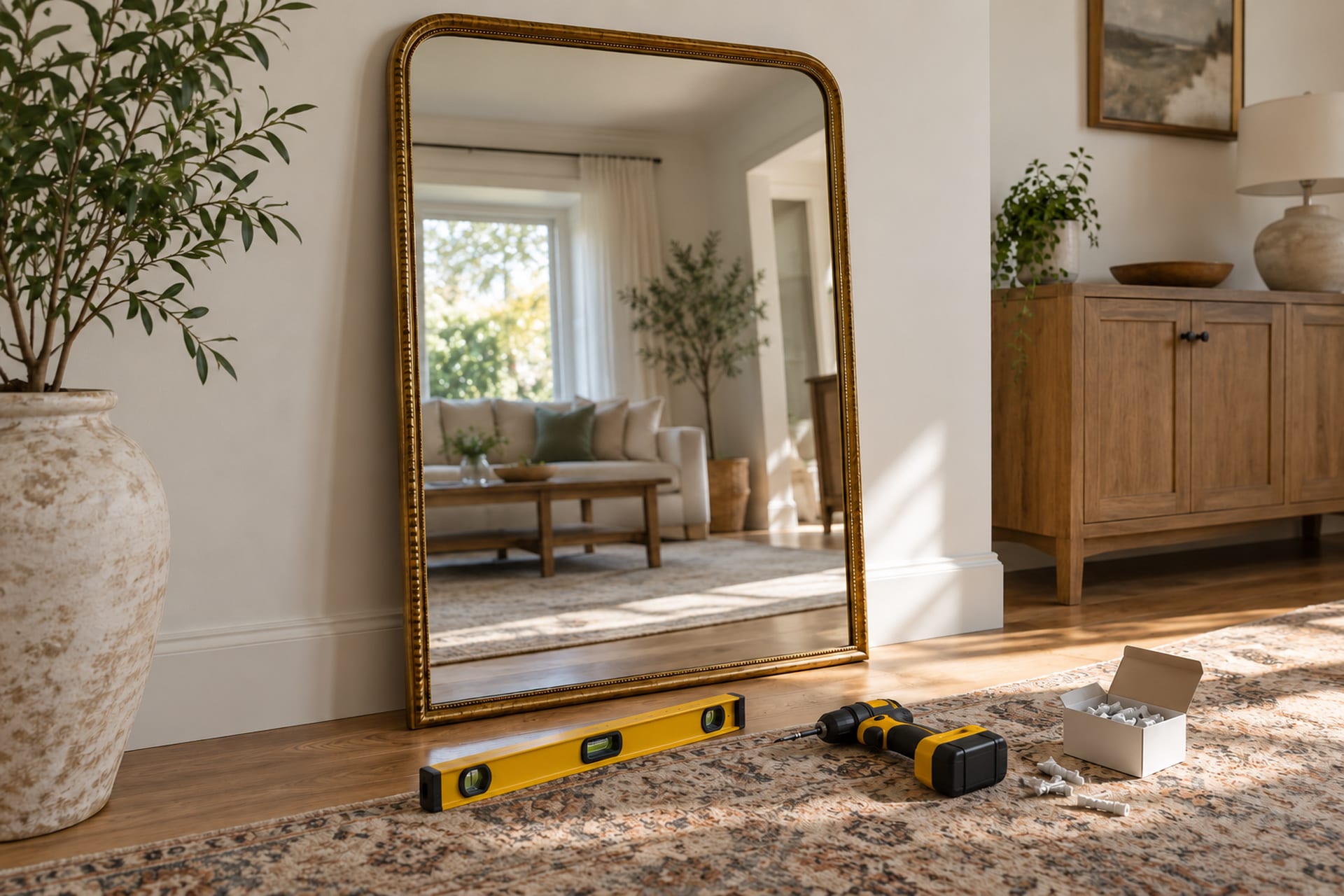
How to hang a heavy mirror comes down to three questions: how much it weighs, what is behind the drywall, and what hardware joins the two. Get those right and a large mirror can hang for decades. Get one wrong and it comes down, usually at night and usually onto something you care about.
This guide covers the whole job, from weighing the mirror to the lift, for framed mirrors like the big pieces on my decorative mirrors list and for wall-hung full-length mirrors. The same steps work for a wall mirror of any size; heavy mirrors simply leave no room for shortcuts.
First, Find Out How Heavy Your Mirror Is
Everything else depends on the weight. The easiest way to find it: step on a bathroom scale holding the mirror, then without it, and subtract. If the mirror is too big to hold, check the maker's listing or estimate from the glass.
Float glass weighs about 2.5 grams per cubic centimeter, which works out to roughly these weights per square foot of mirror:
| Glass thickness | Approx. weight of glass | Example: 30 x 40 in mirror (8.3 sq ft) |
|---|---|---|
| 1/8 in (about 3 mm) | 1.6 lb per sq ft | about 14 lb |
| 3/16 in (about 5 mm) | 2.5 lb per sq ft | about 21 lb |
| 1/4 in (about 6 mm) | 3.3 lb per sq ft | about 27 lb |
That is the glass alone. A wood frame or a thick backing board can add a lot more, so round up. I treat anything over about 20 pounds as a heavy mirror that needs studs or serious anchors, not picture hooks.
Choose the Right Hanging Hardware
The weight ratings below are what each hardware maker states for its own product. The rating of the hanger is only half the story: the screws and the wall must hold the same load.
| Hardware | How it works | Best for |
|---|---|---|
| French cleat or Z-bar | Two interlocking strips, one on the wall, one on the mirror; the mirror drops onto the wall strip | Heavy and wide mirrors, easy leveling |
| D-rings on two hooks | A ring screwed to each side of the frame, each hung on its own screw or hook | Framed mirrors of moderate weight |
| D-rings with wire | Wire strung between two rings, hung on one or two hooks | Lighter framed mirrors; easy to adjust |
| Mirror clips or a J-channel | Clips or a bottom channel grip the edge of the glass | Frameless mirrors, bathrooms, gym panels |
For a heavy framed mirror, I reach for a cleat first. It spreads the load along the whole strip, it sits level by design, and the mirror lifts off easily if you repaint.
What You Need
Hardware for the three main methods. Weight limits are the makers' own figures.
-
1French cleat
AENTGIU 41" French Cleat, 2 Pairs
Two pairs of 41 inch aluminum interlocking cleats that the maker rates at up to 500 pounds, with screws in four lengths, plastic anchors, a drill bit and a small level in the box.
-
2Z-bar
DaTools 18" Z-Bar Hanger, 2 Pairs
Shorter extruded aluminum Z-bars rated by DaTools at up to 90 pounds, for frames up to 30 inches wide; the maker says to use two side by side on wider frames.
-
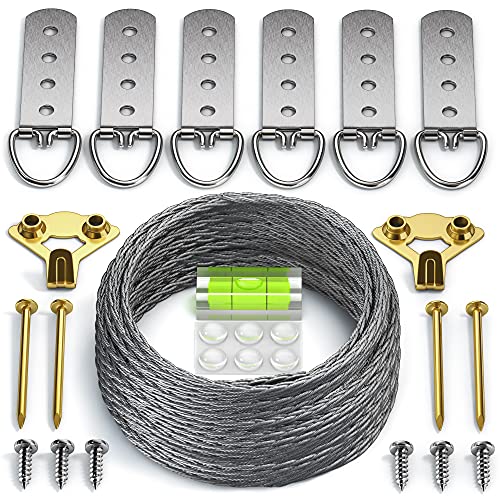
3Wire and hook kit
LuckyBeeBo Heavy-Duty Picture Wire Kit
D-rings, screws, hanging hooks, a level and 50 feet of stainless steel wire, which the maker says can handle from 10 to 100 pounds.
-
4D-rings
PHS Heavy-Duty 2-Hole D-Rings, 50 Pack
Large two-hole D-rings, each rated by PHS at 40 pounds, with screws, for adding hanging points to a wood frame.



How to Hang a Heavy Mirror With a French Cleat
These are the steps I follow for any mirror over about 20 pounds. Read the hardware maker's instructions too: where they differ from mine, theirs win for their product.
Hanging a heavy mirror, step by step
-
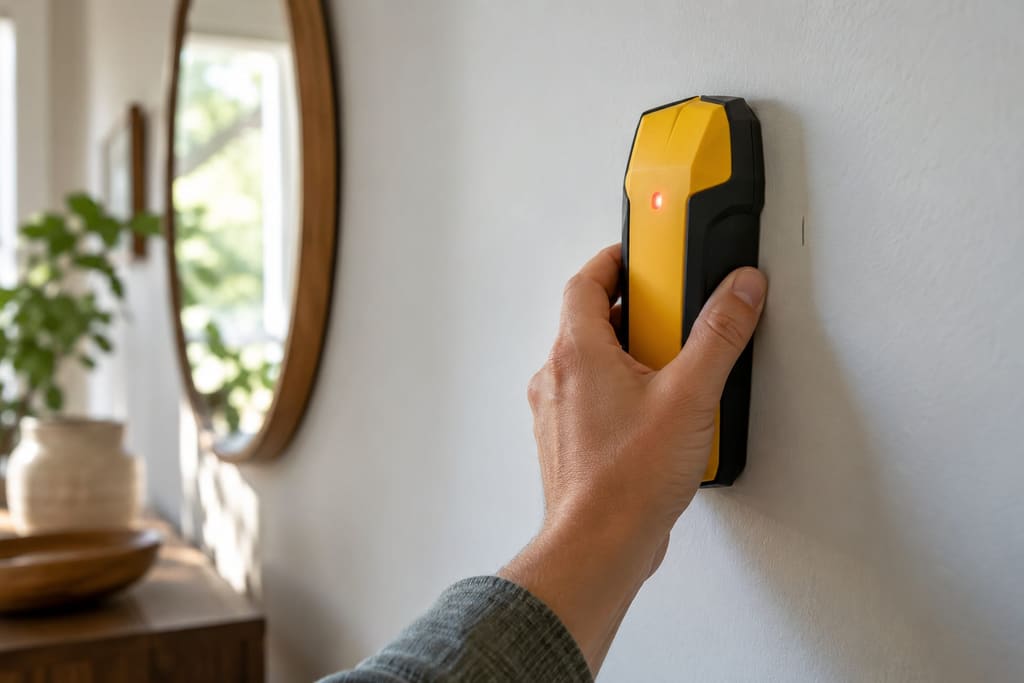
Find and mark the studs
Run a stud finder across the wall where the cleat will go and mark both edges of each stud, then the center. In most US homes studs sit 16 inches apart on center, sometimes 24. Confirm a stud by driving a thin finish nail where the mirror will cover the hole. Also check for pipes and wiring before you drill.
-
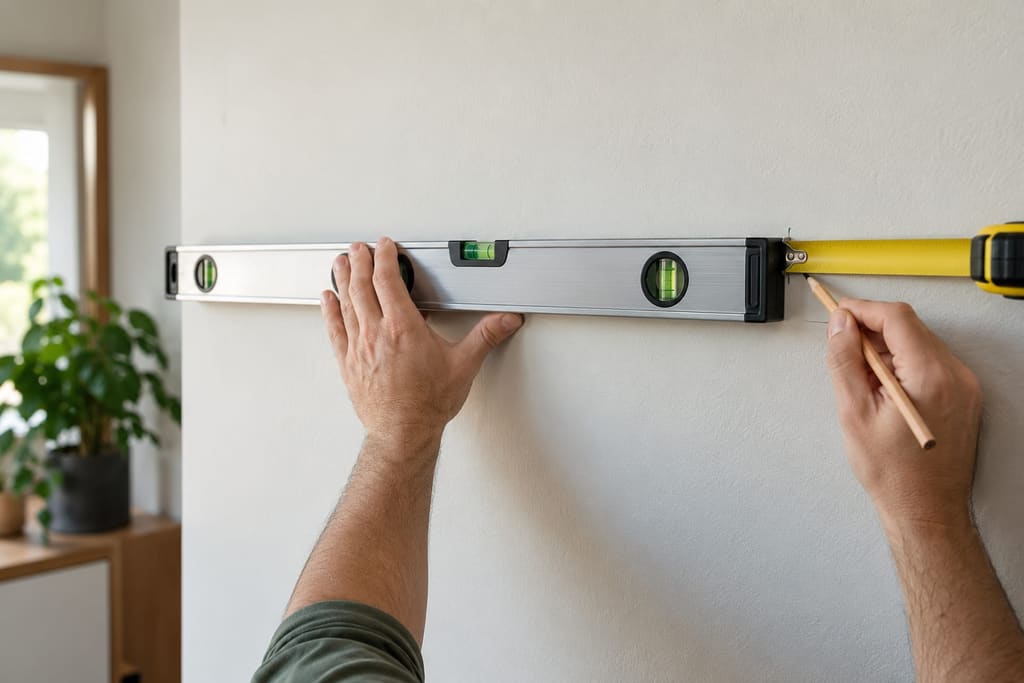
Measure and draw a level line
Decide where the top of the mirror goes. On an open wall, its center usually sits around 57 to 60 inches from the floor; above furniture, leave a few inches of gap. Measure the distance from the top of the frame to where the mirror cleat will sit on the back, subtract it, and draw a level pencil line at that height for the wall cleat.
-
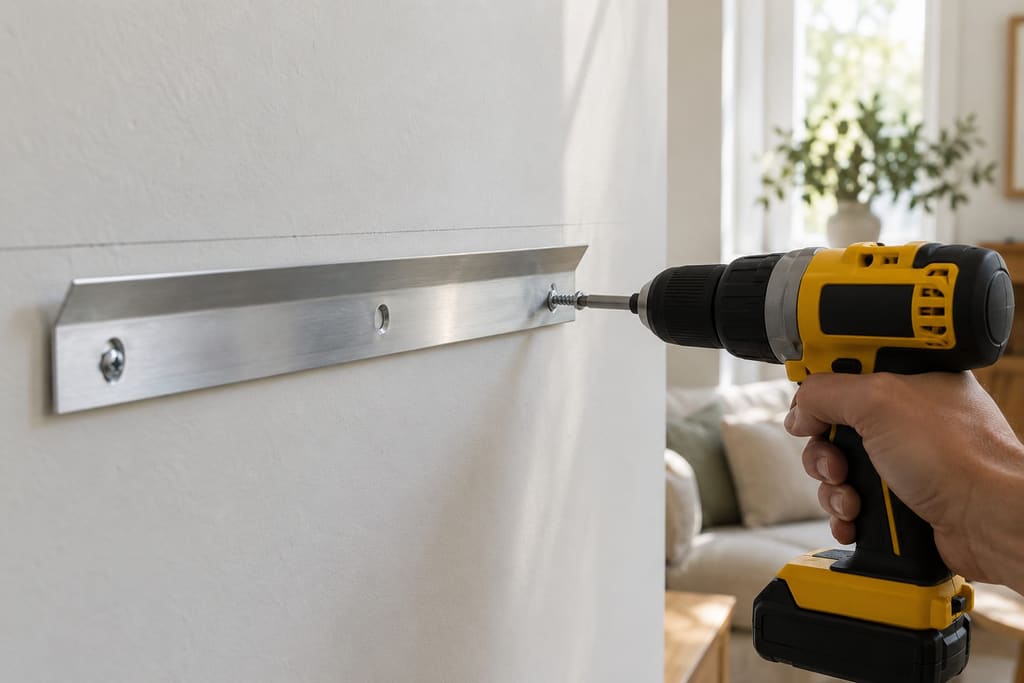
Screw the wall cleat into the studs
Hold the wall cleat on the line with its lip open at the top, angled away from the wall. Drive screws through it into every stud it crosses. Where a screw hole falls between studs, use an anchor rated by its maker for the load, never a plain screw in drywall. Check level again before the last screw.
-
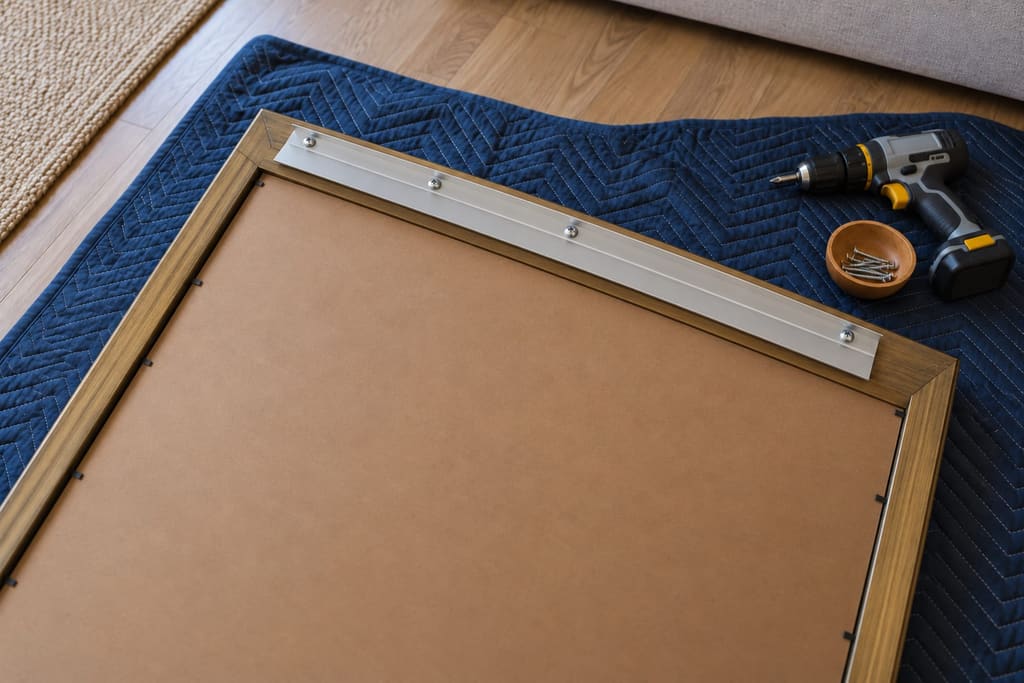
Fix the matching cleat to the mirror
Lay the mirror face down on a blanket. Screw the second cleat across the top rail of the frame, lip pointing down toward the wall side, with screws short enough that they cannot reach the glass. Fix it to solid wood or metal, not to the thin backing board. Add a spacer or felt bumpers at the bottom so the mirror hangs straight.
-
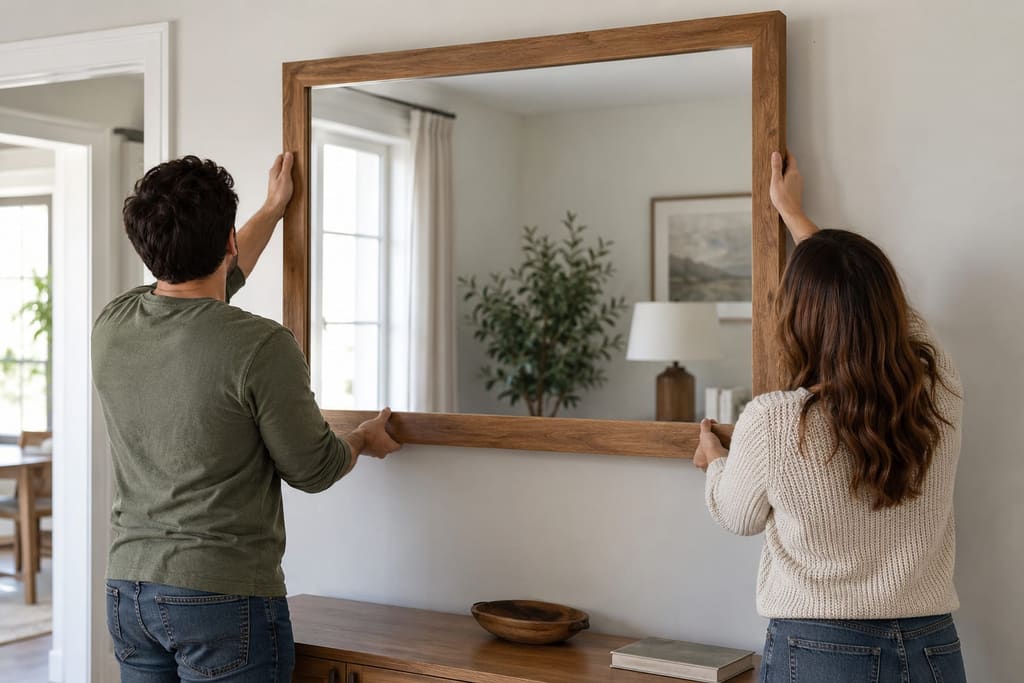
Lift it with a helper and drop it onto the cleat
With one person on each side, lift the mirror slightly above the wall cleat, press it to the wall and lower it until the two cleats lock. Let go slowly, check that it sits level and tight to the wall, and push gently on the bottom corners to confirm it is seated.
How to Hang a Heavy Mirror on Drywall
Drywall itself is a thin sheet of gypsum between paper, and on its own it holds very little. A heavy mirror has to hang from what is behind it or from an anchor designed to spread the load across the back of the board.
Into studs
The best option every time. A cleat long enough to cross two studs puts the whole load into the framing of the house. This is why long cleats are useful even on narrower mirrors.
Between studs
When the studs are not where you need them, use heavy-duty drywall anchors such as toggle bolts or metal self-drilling anchors, and go by the load printed on their package. Plastic expansion plugs that come free with hardware are generally made for light loads; check their rating before trusting them with a mirror. Use several anchors along a cleat rather than one or two.
Plaster and masonry
Old plaster walls crack if you hammer into them; drill pilot holes and use anchors made for plaster. Brick, block and concrete need masonry bits and masonry anchors.
How to Hang a Mirror With D-Rings
D-rings are the right choice for a framed mirror of moderate weight, and many mirrors already have them. Screw one ring to each side of the frame about a third of the way down from the top, into solid wood. Then either hang each ring on its own screw or hook, which keeps the mirror level and stops it tilting, or string wire between them.
For a heavy mirror I prefer two separate hooks to one wire: two hanging points share the load and the mirror cannot swing crooked. If you use wire, keep it fairly taut so the mirror does not lean forward, and choose a wire rated for more than the mirror weighs.
How to Hang a Mirror Without Nails
For light mirrors, adhesive picture-hanging strips can work, as long as you stay within the weight limit printed on the package, the wall is smooth and clean, and the mirror is light enough for the strip maker's guidance. I would not trust adhesive alone with a heavy mirror, and certainly not over a bed or a sink.
For a heavy mirror without drilling, the honest answer is not to hang it at all:
- Lean it on the floor or on a mantel, with grip under the base. My guide on keeping a leaning mirror from sliding shows how.
- Hang it on a door with over-the-door hooks, if it is a slim full-length mirror; see how to hang a mirror on a door.
- Rest it on a sturdy picture ledge that is itself screwed to the wall, which needs a few holes but no hooks on the mirror.
Frameless and Bathroom Mirrors
A frameless mirror has nothing to screw into, so it hangs on mirror clips or sits in a J-channel along the bottom with clips at the top. Mirror adhesive (mastic) is sometimes used too, but it makes the mirror very hard to remove without breaking it. For lighted and LED bathroom mirrors, follow the maker's mounting bracket and instructions exactly, and have a licensed electrician connect any hardwired model. My picks of LED bathroom mirrors note which ones plug in and which are hardwired.
Sources
- Guardian Glass: Physical properties of glass Float glass density of 2,500 kg/m³ and weight per square foot by thickness, behind the weight table.
- U.S. DOE Building America Solution Center: Advanced framing, minimum wall studs Wood-framed houses traditionally use studs 16 inches on center, with 24 inches in advanced framing.
Keep reading: Best decorative mirrors · Full-length floor mirrors · LED bathroom mirrors · How to hang a mirror on a door · Secure a full-length mirror
The MirroRank letter
New mirror picks, sizing and lighting tips from Joan, about once a month.