Mirror guide
Bathroom Mirror Height: How High to Hang Your Vanity Mirror
 By Joan Bardot · Updated 3 sources cited
On this page
A bathroom mirror is hung at the right height when the people using it see their whole face and the top of their head in the middle of the glass, without stooping or stretching. Everything else, the inches from the floor and from the faucet, follows from that.
Get the height right before you choose the mirror, because the two depend on each other: the space between the backsplash and the ceiling light decides how tall the mirror can be. If you are shopping for a lighted model, most LED bathroom mirrors come in fixed sizes, so do the measuring below first. For the width, use my bathroom mirror size chart and calculator.
What Is the Standard Height for a Bathroom Mirror?
There is no single code number for a home bathroom, but designers and installers work with the same three references. Here they are for a standard vanity with a 34 inch countertop:
| Point | Height above the floor | How to find it |
|---|---|---|
| Bottom edge of the mirror | 40 to 45 in | 5 to 10 in above the countertop |
| Center of the mirror | 60 to 65 in | Eye level of the main users |
| Top edge of the mirror | 72 to 80 in | A few inches above the tallest user's head |
| Light fixture above the mirror | About 75 to 80 in | Leave 2 to 4 in between mirror and fixture |
If your vanity is the older 30 to 32 inch height, keep the same distance above the counter: the bottom edge drops to about 36 to 42 inches. If it is a comfort-height vanity at 36 inches, it rises to about 41 to 46 inches.
The eye-level logic
The center of the mirror should sit close to the eye level of the person who uses it most. For adults in the US, standing eye level is roughly 4 to 5 inches below the top of the head, so it lands around 59 inches for someone 5 foot 4 and around 65 inches for someone 5 foot 10. That is why most bathroom mirrors end up with their center between 60 and 65 inches.
When the center is right, the top and bottom take care of themselves. A 36 inch tall mirror centered at 62 inches runs from 44 to 80 inches, which fits a 34 inch counter perfectly. A 30 inch mirror with its bottom 10 inches above that counter (44 inches) is centered at 59 inches, a little low for tall users. That is why, over a standard counter, I prefer mirrors 32 to 36 inches tall.
How High to Hang a Mirror Above the Faucet and Backsplash
Measure up from the countertop, not just from the floor, because counters vary by several inches.
- Above the countertop: 5 to 10 inches to the bottom edge of the mirror.
- Above the backsplash: at least 1 to 2 inches of wall between the top of the backsplash and the glass. Most backsplashes are about 4 inches tall.
- Above the faucet: the faucet can stand in front of the lower part of the mirror; that is normal. What matters is splash. Water that sits on the edge of a mirror works its way behind the silver backing over time and causes the black edges you see on old bathroom mirrors.
A mirror resting directly on the backsplash is a valid look, especially frameless glass cut to fit. If you go that way, have the bottom edge sealed by the installer so water cannot creep behind it.
How Tall Should a Bathroom Vanity Mirror Be?
Work out the space first: from your chosen bottom edge to the highest the top can go (a few inches under any light fixture). On an 8 foot ceiling with a fixture over the mirror, that space is usually 30 to 36 inches. Without a fixture over the mirror (sconces on the sides instead), you can go to 40 inches or more.
Situations That Change the Height
Tall and short people sharing one mirror
Center the mirror at the average of the two eye levels, then choose a mirror tall enough to cover both. For a couple at 5 foot 2 and 6 foot 2, eye levels are about 57 and 69 inches: center around 63 inches and use a mirror at least 36 inches tall, which runs from about 45 to 81 inches and clears the taller person's head. A taller mirror solves more height problems than any careful measuring.
Children
Do not hang the family mirror low for children; they grow and adults pay for it every morning. A sturdy step stool works better. In a kids' bathroom you can lower the bottom edge to the top of the backsplash.
Accessible bathrooms and seated users
According to the 2010 ADA Standards for Accessible Design (section 603.3), a mirror above a lavatory or countertop is installed with the bottom edge of the reflecting surface no higher than 40 inches above the floor. For a home bathroom used by someone in a wheelchair, follow the same number, and consider a taller mirror so standing users are covered too.
Medicine cabinets
A medicine cabinet's door swings sideways, so its bottom edge must clear the top of the faucet spout, usually by 1 to 2 inches, or the door hits the faucet every time you open it. Measure the faucet height before you choose the cabinet's mounting height; tall vessel faucets may push the cabinet up several inches.
Lights above the mirror
A vanity bar light over the mirror usually goes about 75 to 80 inches above the floor. Keep 2 to 4 inches between the top of the mirror and the fixture so the light washes the wall instead of hitting the frame. With side sconces, lighting designers commonly place the center of each sconce near eye level, around 60 to 66 inches.
Tall ceilings
With 9 or 10 foot ceilings, keep the bottom edge in the normal place and add height at the top. Mirrors 40 to 48 inches tall, or an arched mirror, fill the extra wall without lifting the useful part of the glass out of reach.
A seated makeup vanity in the bedroom
For a vanity table where you sit, the logic is the same but the eye level is lower. Seated on a standard stool, most adults have their eyes roughly 45 to 50 inches above the floor, so center the mirror there and keep its bottom edge a few inches above the tabletop. For a magnifying mirror on a swing arm, I mount it so the glass sits at my eye level when I stand at the sink; the arm then lets me pull it closer. My picks of wall-mounted makeup mirrors list the mounting style of each.
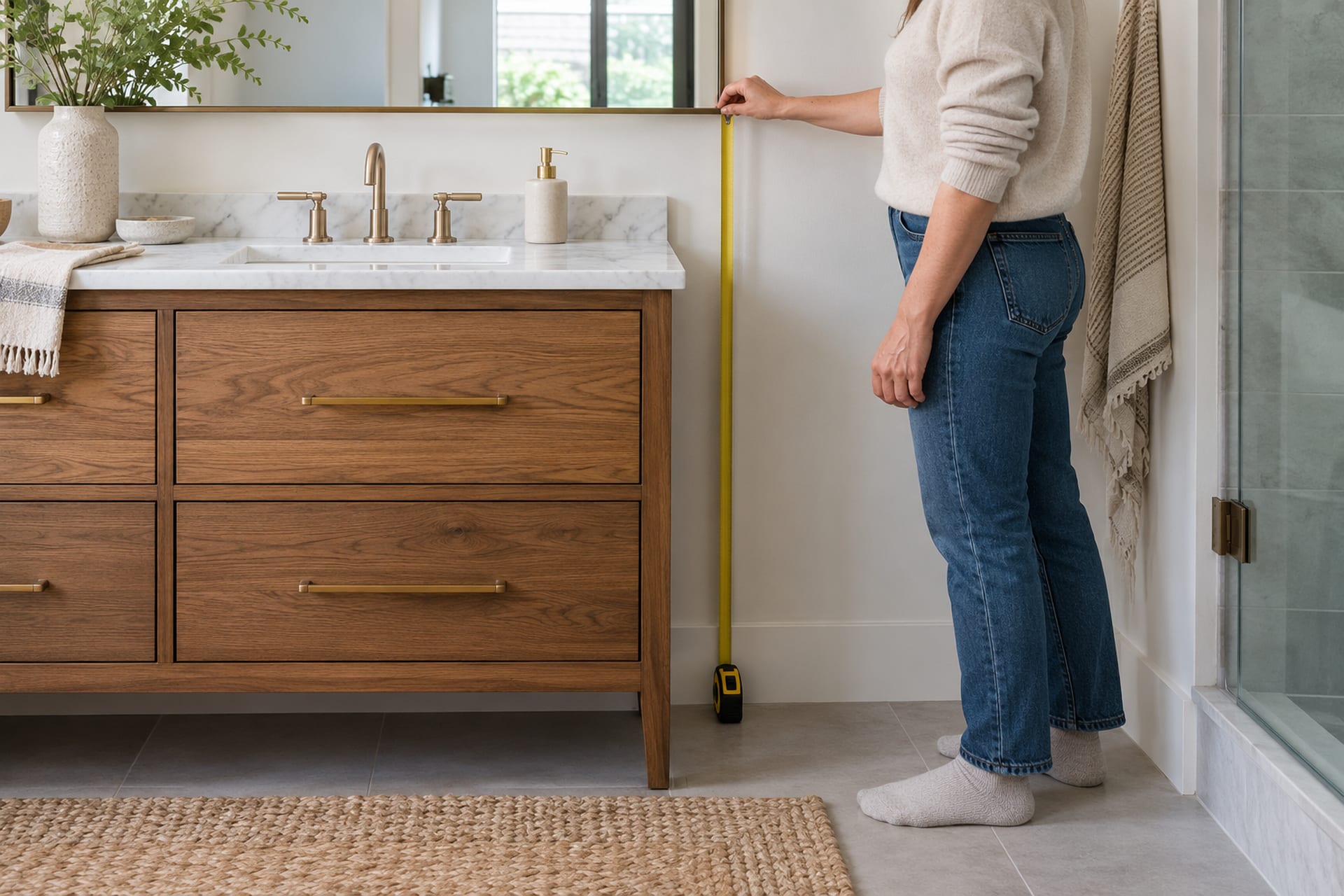
How to Hang a Bathroom Mirror at the Right Height
- Measure the countertop height and the top of the backsplash.
- Choose the bottom edge: 5 to 10 inches above the counter.
- Check the center against the eye level of the main users (60 to 65 inches for most adults).
- Check the top against the light fixture and the tallest user.
- Mark the outline in painter's tape, look at it for a day, then mark the hanging points. On a framed mirror with D-rings or a wire, measure from the top of the frame down to the hanger, not to the frame, before you drill.
Heavy glass needs studs or proper anchors. If your mirror is over about 20 pounds, read how to hang a heavy mirror first.
Sources
- U.S. Department of Justice: 2010 ADA Standards for Accessible Design Section 603.3: mirrors above lavatories or countertops with the bottom of the reflecting surface 40 inches maximum above the floor.
- NKBA: Bathroom Planning Guidelines with Access Standards Lavatory height of 32 to 43 inches to fit the user, a mirror placed with the user's eye height in mind, and vanity task lighting beside the mirror at eye level.
- National Glass Association: Proper Procedures for Cleaning Flat Glass Mirrors (FB06-05) Wet mirror edges cause the damage known as black edge.
Keep reading: Bathroom mirror size chart and calculator · Best LED bathroom mirrors · Best wall-mounted makeup mirrors · How to hang a heavy mirror
The MirroRank letter
New mirror picks, sizing and lighting tips from Joan, about once a month.