Mirror guide
Acrylic vs Glass Mirror: Which One Should You Buy?
 By Joan Bardot · Updated 6 sources cited
On this page
Choose glass when the reflection has to be perfect and the mirror will stay put: bathrooms, vanities, entryways. Choose acrylic when weight or breakage is the bigger worry: kids' rooms, home gyms, portable dance mirrors, doors that slam and anything you move often. Acrylic is roughly half the weight and far harder to shatter, but it flexes, scratches easily and can bend your reflection like a funhouse mirror if it is not mounted flat.
That trade-off decides a lot of the mirrors I recommend. Most of my picks for dance studio mirrors and home gyms come down to exactly this question, so here is how the two materials really compare.
Acrylic vs Glass Mirror: Side by Side
| Acrylic mirror | Glass mirror | |
|---|---|---|
| Reflection | Good when mounted flat; slightly less crisp, can ripple or warp | Sharp and true; the reference for clarity |
| Rigidity | Flexes, especially thin sheets | Rigid |
| Weight | About half of glass | Heavy; large mirrors need serious anchoring |
| Impact | Very hard to shatter; may crack under a hard hit | Breaks into sharp pieces unless tempered or film-backed |
| Scratches | Scratches easily | Highly scratch resistant |
| Cleaning | Mild soap and water, microfiber, no ammonia | Warm water or a mild ammonia-free cleaner on the cloth; no vinegar or ammonia |
| Heat | Can soften or warp near heat sources | Unaffected by household heat |
| Cost | $ to $$ | $ to $$$ (safety backing and size add cost) |
| Best for | Kids' rooms, gyms, portable dance mirrors, doors, RVs, dorms | Bathrooms, vanities, entryways, permanent studio walls |
Why Acrylic Mirrors Distort, and How to Avoid It
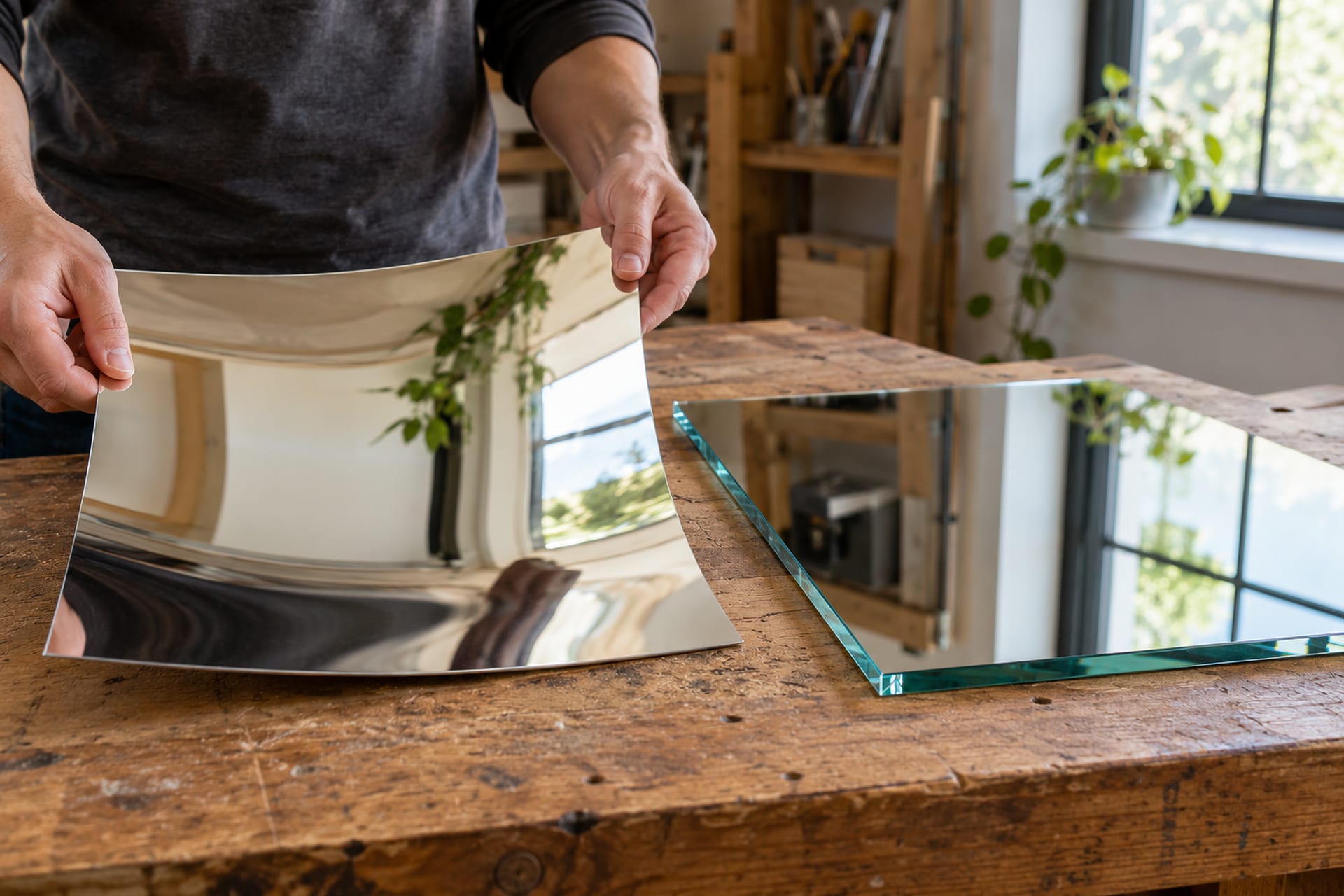
An acrylic mirror is a sheet of clear plastic (PMMA, sometimes called acrylic glass) with a thin reflective metal coating on the back. The coating is excellent. The problem is the sheet: it bends. Any bow, twist or bump in the surface bends your reflection with it, and because a mirror doubles every angle, even a slight curve shows up as a stretched or wavy image. The photo at the top of this page shows it well: the flexed acrylic sheet on the left turns the room into a swirl, while the glass beside it stays crisp.
You can get a very good reflection from acrylic if you treat it right:
- Thicker is flatter. A 1/4 inch sheet holds its shape far better than a 1/8 inch sheet, especially at full-length sizes.
- Mount it on something rigid. A flat backing board, a sturdy frame or a perfectly flat wall. Hanging a thin acrylic mirror from two points is the classic way to get a funhouse effect.
- Check the wall. Drywall is rarely perfectly flat. Adhesive-mounted acrylic follows every dip.
- Avoid heat. Keep it away from radiators, heaters and strong afternoon sun through a window, which can warp it over time.
Glass simply does not have this problem. It is the reason full-length and bathroom mirrors are still almost always glass.
Weight: Why It Matters More Than You Think
Acrylic has a density of about 1.2 grams per cubic centimeter; ordinary soda-lime glass is about 2.5. In practice, an acrylic mirror weighs roughly half as much as a glass one of the same size and thickness. That changes things:
- An over-the-door mirror in acrylic puts much less strain on the door, the hooks and the hinges. If you are hanging one, my guide to hanging a mirror on a door covers the hardware.
- Large gym and dance mirrors in acrylic are easier to carry, install and move, and they need lighter anchoring.
- For renters, a lighter mirror often means fewer and smaller holes.
Unbreakable and Shatterproof Mirrors Explained
"Unbreakable" and "shatterproof" are marketing words, not standards. They are used for several different materials, and it helps to know which one you are buying.
Acrylic mirrors
The most common "shatterproof" mirror. Acrylic is many times more impact resistant than ordinary glass (plastics suppliers commonly quote figures in the range of 10 to 17 times). A hard enough hit can still crack it, but it cracks rather than exploding into sharp shards.
Polycarbonate mirrors
Even tougher than acrylic and close to truly unbreakable in home use, which is why it is used in schools and other high-abuse settings. It scratches more easily still and usually costs more, so it is less common in home mirrors.
Safety-backed glass mirrors
A normal glass mirror with a tough plastic film bonded to the back. The glass can still break, but the film holds the pieces in place instead of letting them fall. Many are tested against the ANSI Z97.1 safety glazing standard; if a maker states that, it is a good sign. You keep the clarity of glass with a much safer failure.
Tempered glass mirrors
Heat-treated glass that is several times stronger than standard glass and breaks into small, blunt granules rather than long blades. Common in shower and frameless mirrors; it cannot be cut after tempering, so it is made to size.
Which Should You Choose for Each Room?
Kids' rooms and nurseries
Acrylic, or safety-backed glass mounted firmly to the wall. For anything at a child's height that could be pulled or knocked, acrylic is the calmer choice.
Home gyms
Both work. Acrylic is lighter and forgiving if a plate rolls into it; safety-backed glass gives a crisper reflection for checking form. If you are mirroring a whole wall, start with my home gym mirror picks.
Dance studios and home practice
Permanent studio walls are usually glass with a safety backing, because dancers need a reflection with no ripple to judge lines. Portable and rolling practice mirrors are often acrylic so they can be moved. Either way, the mirror must be flat: a wavy reflection is worse than none for alignment.
Doors and closets
Acrylic for over-the-door mirrors on doors that get slammed, glass for doors that close gently and where you want a sharp full-length view. Weight matters here, so check it before you buy from my door mirror picks.
Bathrooms and vanities
Glass. It shrugs off steam and frequent wiping with warm water or a mild ammonia-free cleaner, and you want the truest reflection where you do your makeup and shave.
Full-length floor mirrors
Glass for the best reflection; acrylic or safety-backed glass if pets, kids or a narrow hallway make a tip-over likely. For standing mirrors, see my best full-length mirrors.
Dorms, RVs and rentals
Acrylic. It is light, survives moving day and needs less hardware.
Cleaning and Care
Glass is easier: warm water on a soft, lint-free cloth, or a little mild, ammonia-free glass cleaner sprayed onto the cloth, never onto the mirror. Glass makers advise against vinegar or ammonia on mirrors, because they can attack the edges and the silver backing, so dry the edges when you finish. Acrylic needs more care still, and the wrong cleaner can ruin it.
- Use mild soap and lukewarm water, or a cleaner labeled safe for acrylic.
- Avoid ammonia and solvents. Many standard glass cleaners contain ammonia, which can cloud acrylic or cause fine cracking called crazing.
- Use a soft microfiber cloth, never paper towels, which can leave fine scratches.
- Blot, do not scrub. Dust is abrasive; rinse or wipe it away gently before you rub.
Acrylic also builds up static and attracts dust. An anti-static acrylic cleaner helps. For the streak-free method on glass, see my guide on how to clean a mirror without streaks.
Is Acrylic Cheaper Than Glass?
Usually, at small and medium sizes, and especially once you count shipping, because a lighter mirror that cannot break in transit costs less to send. At large sizes the gap narrows: a thick acrylic sheet with a rigid backing, made to stay flat, is not a budget product. Safety-backed and tempered glass add cost over plain glass. In tier terms, a basic acrylic mirror is $, a well-mounted acrylic or plain glass mirror is $ to $$, and large safety-backed glass is $$ to $$$.
Sources
- Plaskolite: OPTIX 99 Acrylic product data Acrylic specific gravity of 1.19 and the maker's statement that it is half the weight of glass and shatter resistant.
- Guardian Glass: Physical properties of glass Float glass density of 2,500 kg/m³ (about 2.5 g/cm³).
- Trinseo: PLEXIGLAS acrylic resins and sheets Maker's figure of acrylic being up to 10 times stronger than glass.
- Plaskolite: OPTIX acrylic sheet FAQs Cleaning with mild soap, water and a microfiber cloth; softening and deforming under sustained heat; expansion with temperature.
- Guardian Glass: Heat-strengthened vs tempered glass Tempered glass is 3 to 4 times stronger than standard glass, breaks into small pieces, and is cut to size before tempering.
- ASC Z97 Committee: ANSI Z97.1, Safety Glazing Materials Used in Buildings The safety glazing standard that safety-backed mirrors may be tested against.
Related: Best dance studio mirrors · Best home gym mirrors · Best over-the-door mirrors · How to hang a mirror on a door
The MirroRank letter
New mirror picks, sizing and lighting tips from Joan, about once a month.