On this page
For most people, a makeup mirror should be 5x. It is strong enough for liner, lashes and concealer, and still shows enough of your face to blend. Add a 10x side if you shape your own brows, and keep 15x and 20x for spot checks. The best setup is two-sided: a flat 1x side for the whole face and a magnifying side for detail.
The number on the box is only half the story, because every step up in magnification makes you sit closer and shows you less of your face at once. Below I go through each level, who it suits, and how close you need to be. If you already know you want strong magnification, for tweezing or for older eyes, my picks for the best magnifying mirrors are a good next stop.
Makeup Mirror Magnification Levels at a Glance
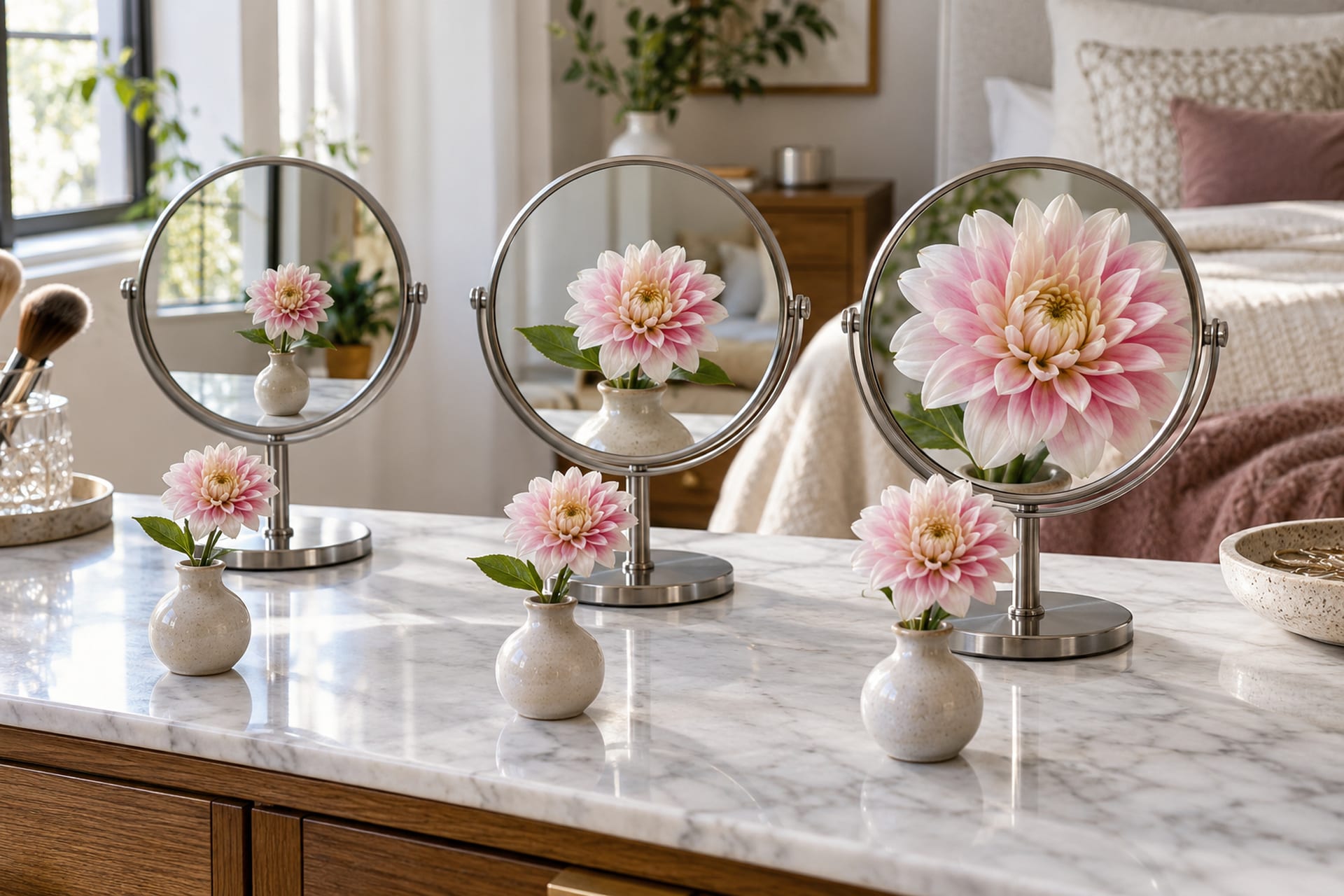
A flat mirror is 1x: your reflection is the same size as your face. A magnifying makeup mirror is concave, curved inward, and the stronger the curve, the bigger the image. The trade-off is always the same: more detail, less face.
| Magnification | Best for | What you see in an 8 inch mirror | Who it suits |
|---|---|---|---|
| 1x (flat) | Foundation, contour, hair, checking the full look | Your whole face and more | Everyone, as the second side |
| 3x | Everyday makeup with a little help | A good part of your face | Good eyesight, people who dislike strong zoom |
| 5x | Liner, lashes, concealer, lip lines | About one eye and brow | Most people; my default recommendation |
| 7x | Detail work with fading near vision | One eye | People in their 40s and beyond who skip readers at the vanity |
| 10x | Brows, tweezing, inner corners, false lash glue | Part of an eye or a short stretch of brow | Brow shaping, poor near vision |
| 15x | Single hairs, close skin checks | A small patch of skin | Very low near vision, occasional precision tasks |
| 20x | Splinters, ingrown hairs, a stray hair you can feel but not see | A few lashes or brow hairs | Spot checks only |
The middle column is a rough geometric estimate: the patch of face you see is roughly the mirror's diameter divided by its magnification (a little more at low power). A bigger mirror shows more, but it does not change how close you need to be.
How Close Do You Have to Be? Working Distance by Magnification
This is the part nobody puts on the box. A concave mirror only gives a sharp, upright image when your face is closer than its focal length, the distance from the glass to its focal point. Move past that point and the image blurs, then flips upside down. Stronger mirrors have a deeper curve and a shorter focal length, so the sharp zone moves closer to the glass.
The physics is the standard concave mirror equation from any introductory physics text: magnification = f ÷ (f minus d), where f is the focal length and d is the distance from your face to the mirror. Makers seldom publish focal lengths, so for the table below I used a working assumption that matches how these mirrors behave in use: a focal length of roughly 40 inches divided by the rating. Treat the figures as a guide, not a specification.
| Magnification | Image blurs beyond about | Comfortable working distance |
|---|---|---|
| 1x (flat) | Never | Any, usually arm's length |
| 3x | 13 in (33 cm) | 8 to 12 in (20 to 30 cm) |
| 5x | 8 in (20 cm) | 5 to 7 in (13 to 18 cm) |
| 7x | 5.7 in (15 cm) | 3.5 to 5 in (9 to 13 cm) |
| 10x | 4 in (10 cm) | 2.5 to 3.5 in (6 to 9 cm) |
| 15x | 2.7 in (7 cm) | 1.5 to 2.5 in (4 to 6 cm) |
| 20x | 2 in (5 cm) | 1.2 to 1.8 in (3 to 4.5 cm) |
Two practical consequences. First, at 10x and above there is barely room for a brush or a mascara wand between your face and the glass. Second, your head blocks the room light at those distances, so a strong magnifying mirror without its own light is hard to use. That is why I almost always recommend a lighted magnifying makeup mirror over an unlit one. If you want the optics in more depth, I explain the focal point in are makeup mirrors concave or convex.
5x vs 10x Magnification: Which Should You Buy?
If you can only have one, buy 5x. It covers eyeliner, lashes, concealer around the nose and the edge of a lip line, and it still shows enough of your face that you can keep both eyes even. You can sit at a normal vanity distance, about a hand's width from the glass, and work with brushes comfortably.
10x is better at one thing: seeing tiny hairs. For tweezing brows, cleaning up the upline of a lash band or checking the inner corner of the eye, it is excellent. For anything you need to blend, it is too close. You see a patch of skin rather than a face, and it is easy to end up with one eye that does not match the other.
The answer most people land on, and the one I give, is a two-sided mirror with 1x and 5x, plus a small 10x mirror for brows. Or a single mirror with 1x on one side and 10x on the other, if brows are the main reason you want magnification at all.
Is 20x Magnification Too Much for Makeup?
For applying makeup, yes. At 20x the sharp zone is under 2 inches from the glass, you see only a few lashes at a time, and the light from the room cannot reach your face. It is a fine tool for finding a stray chin hair, an ingrown hair or a splinter, and for very low near vision some people use it for a single task such as placing a contact lens. But it should be your second or third mirror, never your only one.
The Right Magnification for Each Job
Foundation, contour and blush
1x to 3x. You need to see your whole face to blend evenly and to judge symmetry between the cheeks. Magnification makes blending worse, not better, because you cannot see where the product fades out.
Eyeliner and lashes
5x is ideal, 7x if your near vision is starting to go. You need to see the lash line clearly but still see the whole eye so that the wing angle matches on both sides. For applying strip lashes I like 5x, then a check at 1x to make sure both bands sit at the same height.
Brows and tweezing
10x for individual hairs. Shape the brow at 1x first, so you do not over-pluck, and only then switch to 10x to clean up strays. Over-plucking at high magnification is one of the most common mistakes I see, because at 10x every hair looks like it should go.
Contact lenses
It depends on your eyes. If you are nearsighted, you probably see your own eye clearly up close without lenses, and a flat or 3x mirror is enough. If you are farsighted or have presbyopia, 5x to 7x helps you see the lens and the edge of your iris.
Poor eyesight and makeup over 40
Presbyopia, the gradual loss of near focus, usually becomes noticeable in the early to mid 40s, and it is the main reason people start looking for a stronger mirror. For most people 7x to 10x, with good built-in light and a large diameter, works well. If you need more than 15x to see your own eyelid, talk to your eye doctor before buying a stronger mirror; reading glasses or a different prescription for the vanity may help more than magnification.
Travel and touch-ups
A compact with 1x and 5x, or 1x and 10x, covers almost every touch-up. Small mirrors show less, so the lower power is usually more useful away from home. My best travel makeup mirrors list covers both types.
Other Things That Matter as Much as the Number
- Light. At 5x and above you are close enough to cast a shadow on yourself. Built-in light that is neutral white and has a high color rendering index makes a bigger difference than an extra step of magnification. My guide to the best lighting for makeup explains the numbers.
- Diameter. A larger mirror shows a bigger patch of face at the same magnification. At 10x, the difference between a 6 inch and a 9 inch mirror is roughly the difference between half an eye and most of one.
- Mounting. High magnification is easier on an extending arm that you can pull to your face. If you do your makeup at the bathroom sink, a wall-mounted magnifying mirror is worth a look.
- Glass quality. A well-ground concave mirror stays sharp to the edge. Cheaper ones distort toward the rim, and the higher the magnification, the more that shows.
Sources
- OpenStax: College Physics 2e, 25.7 Image Formation by Mirrors The concave mirror equation and magnification used for the working distance table.
- The Physics Classroom: Image characteristics for concave mirrors Upright magnified image inside the focal point, inverted beyond it.
- American Academy of Ophthalmology: What is presbyopia? Presbyopia is usually noticed shortly after age 40.
- National Eye Institute: Presbyopia Everyone gets presbyopia with age, usually after 45.
Related: Best magnifying mirrors · Best lighted makeup mirrors · Best travel makeup mirrors · Are makeup mirrors concave or convex?
The MirroRank letter
New mirror picks, sizing and lighting tips from Joan, about once a month.