On this page
Feng shui mirror placement is one of the most searched corners of home decorating, and one of the most contradictory. Feng shui is a traditional Chinese practice for arranging spaces, and its advice on mirrors is a set of beliefs about energy, or chi, not something that can be measured. I write about it the way I'd talk about it with a client: here is what practitioners say, where they agree, where they don't, and the plain design reasons that often lead to the same spot on the wall.
I've gone through the guidance room by room, comparing several practitioners and design sources for each rule. Where one room already has its own detailed guide on this site, I keep this section short and point you there. If you're choosing the mirror itself, my picks for the best decorative mirrors and the best full-length floor mirrors are a good place to start.
Feng Shui Mirror Placement: the Principles
Before the room-by-room rules, it helps to know the ideas they come from.
Mirrors Double What They See
Every source I read starts here: a mirror is believed to amplify whatever it reflects. Castlery's guide puts it as making sure the reflection is "worth doubling", and Cox & Cox describes mirrors as reflecting "energy as well as appearances". That is why the advice is always about the view as much as the wall: a mirror facing a window or a plant is welcomed, and one facing a pile of shoes is not.
Mirrors Move Energy Around
Practitioners describe mirrors as able to pull energy into a space or push it away. The feng shui consultant Anjie Cho, quoted by Livingetc, describes mirrors as "both yin and yang". That double nature is the root of most disagreements, especially about front doors.
Different Schools, Different Answers
There isn't one feng shui. Livingetc's piece on mirrors facing doors contrasts Cho, who practises in the BTB school, with the feng shui master Marie Diamond, and they reach opposite verdicts. When two practitioners disagree, I treat that as a sign the rule is flexible, and fall back on what looks and works best in the room.
Room by Room: Where to Put a Mirror
This table compares what practitioners commonly advise in each room with the practical design view. The sources behind each line are listed at the end of the article.
| Room or spot | What practitioners commonly advise | Do they agree? | Practical design view |
|---|---|---|---|
| Facing the front door | Avoid; hang it on a side wall or angle it away | Mostly; BTB practitioners allow it | A side wall shows you on the way out and doesn't dazzle you on the way in |
| Hallway | Good for small, dim halls; mid-corridor rather than at the end | Yes | Mirrors brighten and widen narrow spaces |
| Bedroom, facing the bed | Avoid, or cover at night | Yes | Reflected movement and light can be distracting in a dark room |
| Above the bed | Avoid | Yes | A heavy mirror over your head is a real hazard if poorly fixed |
| Dining room | Split: some reflect the table for abundance, others say don't see yourself while eating | No | Reflect the table and the light, not the diners' faces |
| Living room | Reflect something pleasant; avoid clutter and the TV | Mostly | Opposite a window doubles daylight |
| Bathroom | Don't reflect the toilet | Yes | Over the sink is where you need it anyway |
| Kitchen and stove | Split: some say never behind the stove, others say it multiplies wealth | No | Grease and heat make mirrors hard to keep clean there |
| Stairs | Split: avoid facing the stairs, or welcome mirrors on landings | No | Safety first: never a mirror that confuses a step |
| Office or desk | Usually avoid behind the desk | Mostly | A mirror behind you on video calls is distracting |
The Front Door and Entryway
Should a Mirror Face the Front Door?
This is the question I get asked most, and the honest answer is that practitioners disagree. Feng Shui Balanz says plainly that "a mirror should not face directly towards the main door", and suggests that a mirror beside the door goes on the side opposite the door's swing. Cox & Cox advises hanging mirrors perpendicular to doorways rather than opposite them. Castlery says a mirror directly opposite the door can send incoming energy straight back out, and suggests angling it to the side. Marie Diamond, quoted by Livingetc, calls the front door "the mouth of chi" and also advises against a mirror directly opposite. Anjie Cho, in the same article, says a mirror facing the front door can be fine in the BTB school.
What to Do If Yours Already Faces the Door
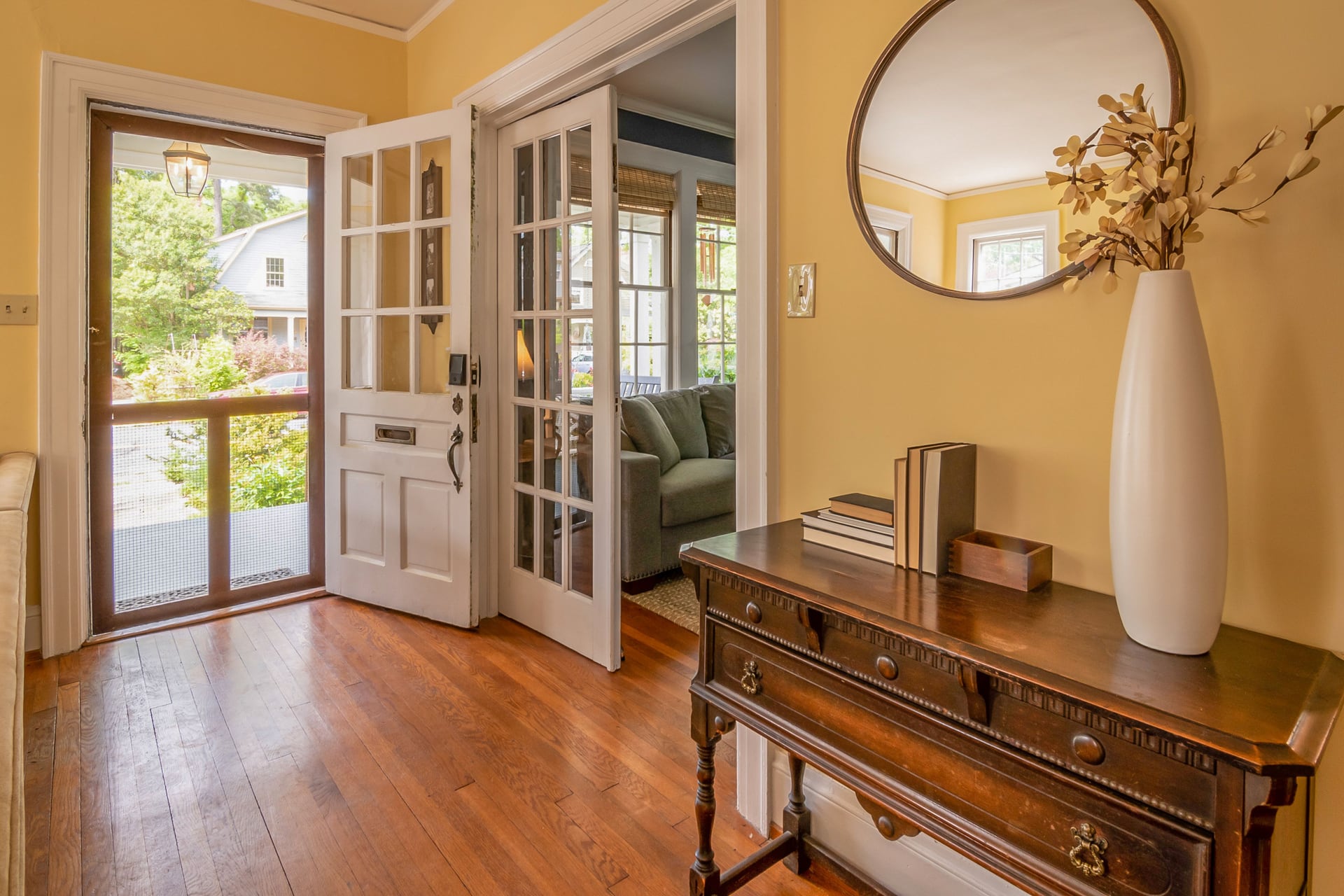
Diamond's suggestion is to angle the mirror so it doesn't reflect the door directly, and to use plants or artwork on the side walls to draw energy in. From a design point of view, I agree with moving it: a mirror on the side wall of an entryway is more useful, because you can check yourself on the way out without walking towards your own reflection.
Hallways
Narrow, dark hallways are where everyone agrees mirrors help. Cox & Cox recommends them for small, dim hallways, and Feng Shui Balanz prefers a mirror mid-corridor rather than at the far end, where it is said to push energy back. For hanging, my guide to hanging a heavy mirror covers the hardware.
The Bedroom
Mirrors Facing the Bed
The bedroom is the one room where the sources line up. Feng Shui Balanz advises against a mirror directly across from the bed, Castlery says to keep mirrors off the wall facing the bed and the bedroom door, and Cox & Cox calls the bedroom "a very sensitive area" where misplaced mirrors may disrupt sleep. Covering the mirror at night, with a curtain or a closed wardrobe door, is the usual fix. I've written a full guide on where to put a floor mirror in the bedroom and whether it should face the bed, so I won't repeat it here.
Mirrors Above the Bed
Practitioners also advise against hanging a mirror above the bed. Cox & Cox's reasoning is that it is "difficult to relax with something weighty above you". That one has a practical side too: a large mirror over a headboard has to be fixed properly, because it is directly over your head.
Where a Bedroom Mirror Works
A side wall, the inside of a wardrobe door or a full-length mirror beside the dresser keeps the mirror useful without facing the bed. My guide to the best over-the-door mirrors covers the wardrobe-door option.
Dining Room, Living Room, Kitchen and Bathroom
Dining Room
Here the advice splits. Castlery suggests a mirror facing the dining table, linking it with abundance and conversation. Feng Shui Balanz says not to place a mirror where you see yourself while seated, allows one behind you beside the table, and calls the idea that a mirror doubles food or wealth a myth. My dining room mirror guide covers sizes and positions in detail.
Living Room
Practitioners agree on the general idea of reflecting something attractive. Cox & Cox considers a mirror opposite a window good, because "greenery, sky and natural light" create positive energy, while Feng Shui Balanz suggests avoiding reflecting windows and the TV in the living room. A mirror that reflects a window is also the oldest designer's trick for making a room feel bigger and brighter.
Kitchen and Stove
Feng Shui Balanz says a mirror should not be placed in the kitchen, and never behind the stove. Other feng shui guides take the opposite view and describe a mirror behind the burners as multiplying the prosperity the stove is said to represent. With practitioners pointing in opposite directions, I'd decide on practical grounds: a mirror splashback near a hob needs constant cleaning, and heat and grease are hard on mirror edges.
Bathroom
Two sources agree that the bathroom mirror shouldn't reflect the toilet: Castlery and Cox & Cox both say so, and Feng Shui Balanz adds that the mirror belongs over the sink. That suits function too. For choosing one, see my best bathroom wall mirrors.
Stairs, Offices and Special Cases
Stairs and Landings
Feng Shui Balanz advises against mirrors facing the staircase and says a mirror at the top should not reflect the top of the stairs, especially with children or older people in the house. Cox & Cox and Castlery are more positive about mirrors on a stair wall or landing to open up tight corners. Whatever you believe, safety decides this one: a mirror should never make it harder to see where the next step is.
Office and Desk
Feng Shui Balanz generally advises against mirrors in the office or behind a desk, with an exception for one that reflects a decorated "wealth corner". Castlery locates the wealth corner as the far-left corner from the doorway.
Bagua Mirrors
Bagua mirrors, small mirrors set in an octagonal frame of trigrams, are a separate tradition. Feng Shui Balanz says they are for use outside the home only, typically above the front door, and should not be hung indoors.
Sources
- Feng Shui Balanz: Mirror placement rules Front door, entryway, bedroom, dining room, living room, kitchen and stove, bathroom, stairs, office and bagua mirror guidance.
- Cox & Cox: Mirror feng shui style notes Doorways, hallways, stairs, bedroom and above the bed, social spaces, windows, toilets, height.
- Castlery: Feng shui mirror placement Front door, bedroom, dining table, wealth corner, toilet and staircase landing guidance.
- Livingetc: Is it okay to have a mirror facing a door in feng shui? Anjie Cho (BTB school) and Marie Diamond on mirrors facing the front door.
Keep reading: Mirrors in the bedroom · Mirrors in the dining room · Best decorative mirrors · Best floor mirrors
The MirroRank letter
New mirror picks, sizing and lighting tips from Joan, about once a month.