
On this page
If you are asking how high a vanity light should be, the short version is 72 inches from the floor to the middle of the fixture, with some room to go higher if the ceiling is tall. That one number settles most bathrooms, but the details change with the ceiling, the mirror and whether the light sits above the glass or beside it.
Below I go through the standard height, the adjustment for 8, 9 and 10 foot ceilings, side sconces versus a bar over the mirror, how wide the fixture should be on a 30 or 60 inch vanity, whether to point it up or down, and how to mark the wall before any wiring is cut. I leave the height of the mirror itself to my guide on the standard vanity mirror height, since the two measurements work together.
Standard Vanity Light Height
Two respected lighting sources give two slightly different numbers, and the difference is only where they measure from. Kichler's bathroom lighting guide says the centerline of the vanity light should be hung 72 inches above the floor. Hunker's guide to vanity light height puts a fixture mounted above the mirror so that the bulb is 75 to 80 inches above the floor. If you take the center of a fixture a few inches tall, those descriptions land in the same place: the light sits just over a standing adult's eye line, above the mirror, shining down onto the face.
Height Above the Floor
Use 72 inches to the center of the fixture as your starting mark. Kichler allows the height to rise to 80 inches for taller ceilings or taller people, but says it should never exceed that. So the working range is 72 to 80 inches, and for a typical bathroom I'd stay at the low end of it. A light at 72 inches is high enough that you do not look into the bulb, and low enough to keep the beam on your face rather than on the ceiling.
Measure to the center of the fixture, not its top or bottom edge. A tall fixture and a slim bar can share the same centerline and still hang very differently, which is why trusting a number from a product page without checking where it was measured gives wrong results.
Height Above the Mirror
The other measurement is the gap between the top of the mirror and the bottom of the fixture. There is no single agreed number for it. Hunker gives a different rule for a round mirror, placing the fixture 2 inches above the top of it, and says a rectangular mirror should hang at least 5 inches above the vanity top. Treat the gap as a practical question: the fixture needs room to clear the glass and its frame, and enough space that you can still reach and clean both.
In practice the gap is set by the mirror, not the other way around. Pick the mirror height first, then place the light so its centerline is near 72 inches and its body clears the frame. If those two goals clash, because a tall mirror pushes the light too high, move to a shorter mirror or to side sconces. The bathroom mirror size guide helps you choose the mirror that leaves room.
Vanity Light Height by Ceiling Height
Kichler gives two figures: 72 inches as the centerline, and 80 inches as the ceiling on how high it can go for taller ceilings or taller people. It does not give a separate number per ceiling height. The table below uses those two limits, plus simple subtraction to show how much wall is left above the fixture, and a plain rule of thumb that I have labeled as mine.
| Ceiling | Ceiling in inches | Space above a 72 inch centerline | What I'd do |
|---|---|---|---|
| 8 ft | 96 | 24 inches | Stay at 72. Rule of thumb, not a published figure. |
| 9 ft | 108 | 36 inches | 72, or a little higher if the household is tall. Rule of thumb. |
| 10 ft and up | 120 and up | 48 inches or more | Up to 80, the limit Kichler gives. Never above it. |
8 ft Ceilings
On an 8 foot ceiling a 72 inch centerline leaves 24 inches between the center of the fixture and the ceiling, which is plenty. There is no reason to go higher. Raising the light on a low ceiling only moves it toward the ceiling and away from your face, and it does not help the shadows at all. If a fixture looks crowded, the better fix is a slimmer fixture or a lower mirror rather than a higher light.
9 ft Ceilings
A 9 foot ceiling leaves 36 inches above a 72 inch centerline. That is a comfortable proportion, and 72 inches still works well. If everyone who uses the bathroom is tall, nudging the fixture up a few inches is reasonable, as Kichler allows for taller people. I would measure the tallest user's eye line against the wall with tape before committing.
10 ft and Taller Ceilings
This is where the 80 inch upper limit matters. On a 10 foot ceiling the wall above a 72 inch centerline is 48 inches, so a fixture at 72 can look low. Raising it toward 80 inches is within Kichler's allowance. Beyond 80, the light is too far from your face to do its job as task lighting, and that is the point where I would add side sconces or a second light rather than climbing higher.
Side Sconces vs a Bar Above the Mirror
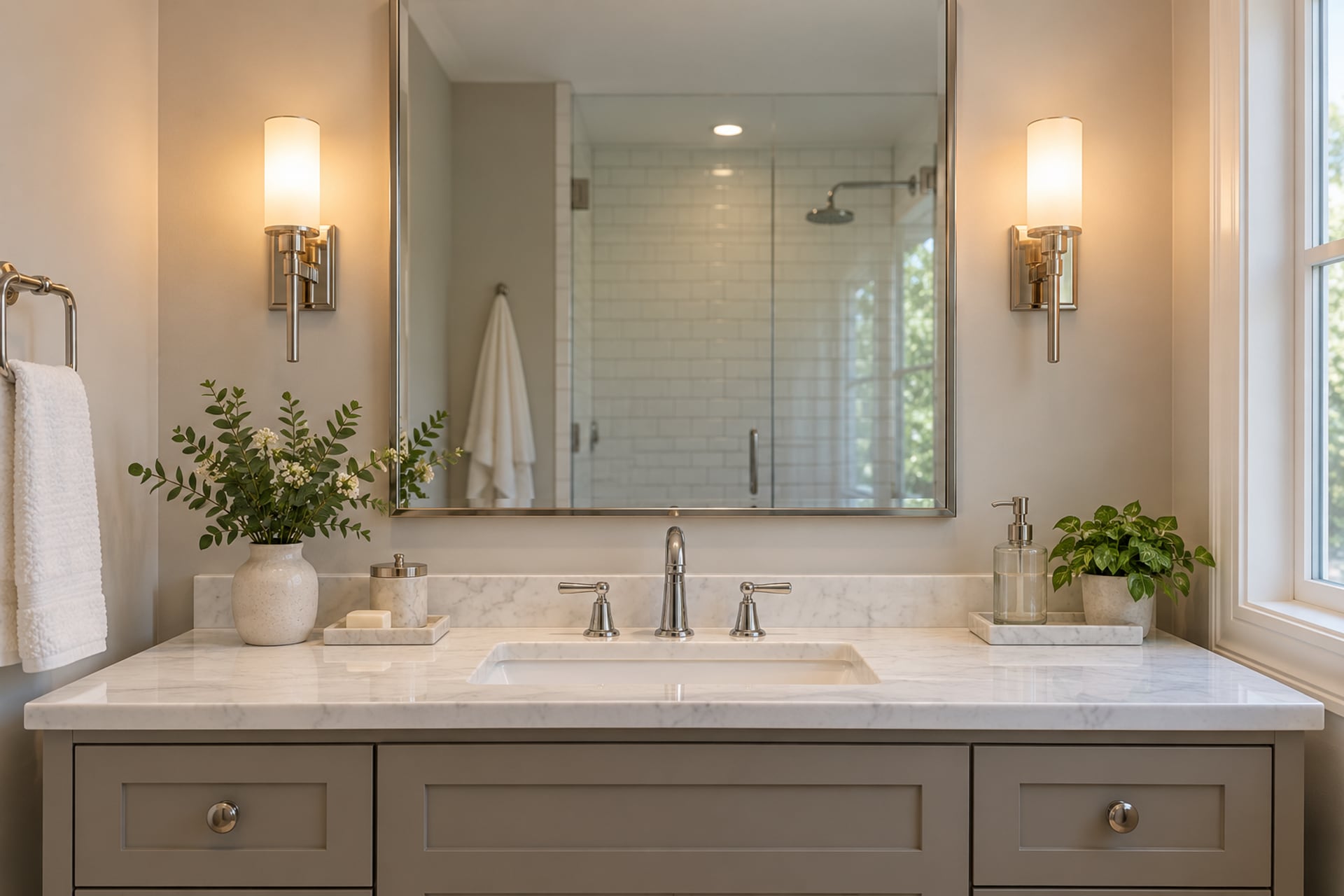
Kichler calls sconces the preferred method for bathroom lighting when it is used for personal grooming. It also says that pairing sconces with a recessed light positioned in line with the sink drain delivers light from three directions, which eliminates shadows. A bar above the mirror lights the face from above, so it casts shade under the brow, nose and chin. Light from the sides lands on both cheeks evenly.
Sconce Height
Hunker's rule is to position the center of each sconce at roughly eye level, within a range of 60 to 70 inches from the floor. That is lower than the 72 inch centerline for a bar, because the aim is different: the bar is lighting the mirror from above, the sconce is lighting your face from the side. Choose the number inside the range that matches the shortest regular user's eye height, then check the shade hides the bulb from direct view.
Sconce Spacing
Hunker puts the ideal distance between sconces at 36 to 40 inches and warns that wider gaps leave dark spots in the middle, right where the mirror hangs. That tells you the mirror needs to fit between them too. A mirror about the width of that gap, with a sconce on each side, is the layout most guides draw. Measure your own mirror before you buy fixtures so the wall space matches.
Why Side Light Is Better for Makeup
For applying makeup, even light with no shadow on the face matters more than brightness. Side light gives you that, and overhead light does not. If makeup is the main job of the mirror, I would put sconces first and a bar light second. My guide to the best lighting for makeup covers color temperature and what to look for in a bulb, and if you would rather buy a mirror with the light built in, see my picks for the best lighted vanity mirrors and the best LED bathroom mirrors.
How Wide Should a Vanity Light Be?
Kichler's width rule is simple: the full width of the vanity light should not exceed the width of the mirror. It also says a 3 light fixture, or a 24 inch one, is usually considered the minimum for seeing yourself well, and that the number of lights depends on the size of the mirror and the room. Center the fixture on the plumbing, over the mirror.
A 30 Inch Vanity
Kichler does not name a size for a 30 inch vanity, so this is my reading of its two limits. A 30 inch vanity usually carries a mirror of about the same width or a little less, and the fixture must stay inside the mirror's width. That puts a 24 inch fixture, Kichler's stated minimum, comfortably in range. Measure your actual mirror, not the vanity, since the mirror sets the ceiling.
A 60 Inch Vanity
A 60 inch vanity is usually a double sink, which changes the question. Kichler gives no figure for it either. Following its rule, one long fixture must still fit within a single wide mirror, and if there are two mirrors, each sink can have its own light centered on its own mirror. The second layout often looks better and lights each person properly, because a single bar spreads thinly across a wide span.
Up or Down? Which Way the Light Should Face
Some fixtures can be mounted with the glass or diffuser facing up or down, and Kichler describes the trade-off. With the bulb facing down, you get more light but more glare. With the diffuser facing up, some light is blocked, but the glare is reduced. Hunker adds the aim that matters for faces: you want the fixtures to cast light across your face, not from above or below it.
For a bar above the mirror, I would choose the downward mount if the shade is frosted or the bulbs are shielded, because the extra light is worth having. If you see glare in the mirror or squint when you lean in, flip it up. The right answer depends on the shade, not on a rule, and you can test it for a day with the fixture temporarily hung before you fix it for good. For sconces, the question mostly disappears, because side light already crosses the face.
Before the Electrician Comes
The wiring box goes in before the fixture, so the height has to be decided first. If you are setting a height after the wall is closed, you are stuck with wherever the box ended up.
Rough-In Box Height
The rough-in box should sit so the finished fixture lands on your chosen centerline. Work backward: pick the fixture, find where its mounting plate sits relative to its center on the maker's instruction sheet, and mark the box position from that. Different fixtures put the mounting point in different places, so a box placed for one design may not suit another. If you have not picked a fixture, ask the installer to leave the wiring long enough to adjust, or choose the fixture before the wall is opened.
Measure With Tape First
Before anything is cut, stick painter's tape on the wall at 72 inches, at 80 inches, and across the width of the mirror. Stand at the vanity and look. Bring the tallest and shortest users to check the eye line, and hold the fixture or a cardboard cutout of its size against the tape. It costs nothing, and it shows problems that a tape measure alone does not, like a fixture that would crowd the mirror frame.
Sources
- Kichler: Bathroom Lighting Planning & Selecting Tips Centerline 72 inches above the floor, up to 80 inches but never higher; fixture width not above mirror width; 3 light or 24 inch fixture as the usual minimum; sconces preferred for grooming; up and down mounting trade-off.
- Hunker: What Is The Ideal Bathroom Vanity Light Height? Bulb 75 to 80 inches above the floor for a fixture over the mirror; sconces at eye level, 60 to 70 inches, 36 to 40 inches apart; light across the face rather than from above or below.
Keep reading: Standard vanity mirror height · Best lighting for makeup · What size should your bathroom mirror be · Best lighted vanity mirrors · Best LED bathroom mirrors
The MirroRank letter
New mirror picks, sizing and lighting tips from Joan, about once a month.