Mirror guide
How to Hang a Full Length Mirror, or Keep a Leaning One From Sliding
 By Joan Bardot · Updated 4 sources cited
On this page
A full-length mirror can fail in two ways: it hangs at a height where you cannot see your shoes, or it leans against the wall until the base slides out and it comes down face first. Both are easy to prevent, and neither needs much more than a tape measure, a stud finder and the right small hardware.
This guide covers both, hanging and leaning. If you are still choosing the mirror, my picks of the best full-length floor mirrors note which ones come with wall hardware or an anti-tip kit.
Hang It or Lean It?
| Hang on the wall | Lean against the wall | Over the door | |
|---|---|---|---|
| Floor space | None | A strip about 10 in deep | None |
| Holes in the wall | Yes | One small one for the strap | None |
| Safety with kids and pets | Best | Only with an anti-tip strap | Good with a door stop |
| Easy to move | No | Yes | Yes |
For a door, the method is different; I cover it in how to hang a mirror on a door.
How High to Hang a Full Length Mirror
A flat mirror shows you your whole body when it is half your height and hung in the right place. This is basic optics, not a design opinion: light from your feet reflects to your eyes from a point halfway between them on the mirror, and light from the top of your head from a point halfway between your eyes and your crown. How far you stand from the mirror makes no difference.
So, for one person:
- Top edge: halfway between your eyes and the top of your head, in practice about 2 inches below your full height.
- Bottom edge: half the height of your eyes from the floor.
| Your height | Minimum mirror height | Top edge from the floor | Bottom edge from the floor |
|---|---|---|---|
| 5 ft 0 in (60 in) | 30 in | about 58 in | about 28 in |
| 5 ft 6 in (66 in) | 33 in | about 64 in | about 31 in |
| 6 ft 0 in (72 in) | 36 in | about 70 in | about 34 in |
When several people share the mirror
Use the top edge for the tallest person and the bottom edge for the shortest. For a household of 5 foot 2 and 6 foot 2, that means a top edge around 72 inches and a bottom edge around 29 inches: a mirror about 44 inches tall. Most full-length mirrors are taller than that, which gives you slack; I would still keep the top edge a couple of inches above the tallest person's head so nobody feels cut off.
How to Hang a Full Length Mirror on a Wall
- Weigh the mirror. Stand on a bathroom scale holding it, then subtract your own weight. Choose hardware rated for well over that number.
- Find the studs. Wall studs in American homes are usually 16 inches apart on center. A screw into a stud holds far more than any drywall anchor.
- Choose the hardware. D-rings on each side of the frame with screws into studs or rated anchors; a French cleat for heavier mirrors; mirror clips for frameless glass.
- Mark the hanging points. Measure from the top of the frame down to each D-ring (or to the top of the cleat), then transfer that to the wall from your chosen top edge. Use a level between the two marks.
- Hang it with a helper and check the level again before you let go.
Avoid hanging a full-length mirror on a single wire and a single hook. It tilts every time it is touched, and all the weight sits on one point. Two D-rings, or a cleat, keep it straight. For mirrors over about 20 pounds, the details on anchors and drywall are in how to hang a heavy mirror.
How to Keep a Leaning Mirror From Sliding
A leaning mirror slides for three reasons: the floor is smooth, the angle is too steep, or there is nothing under the base to grip. Fix all three and it stays put.
Get the angle right
Lean it gently. A lean of roughly 5 to 10 degrees from vertical is enough; on a mirror about 60 inches tall, that puts the base about 5 to 10 inches out from the wall. Too steep (base far from the wall) and gravity pushes the base outward. Too upright and the mirror can rock forward when someone brushes it.
Put grip under the base
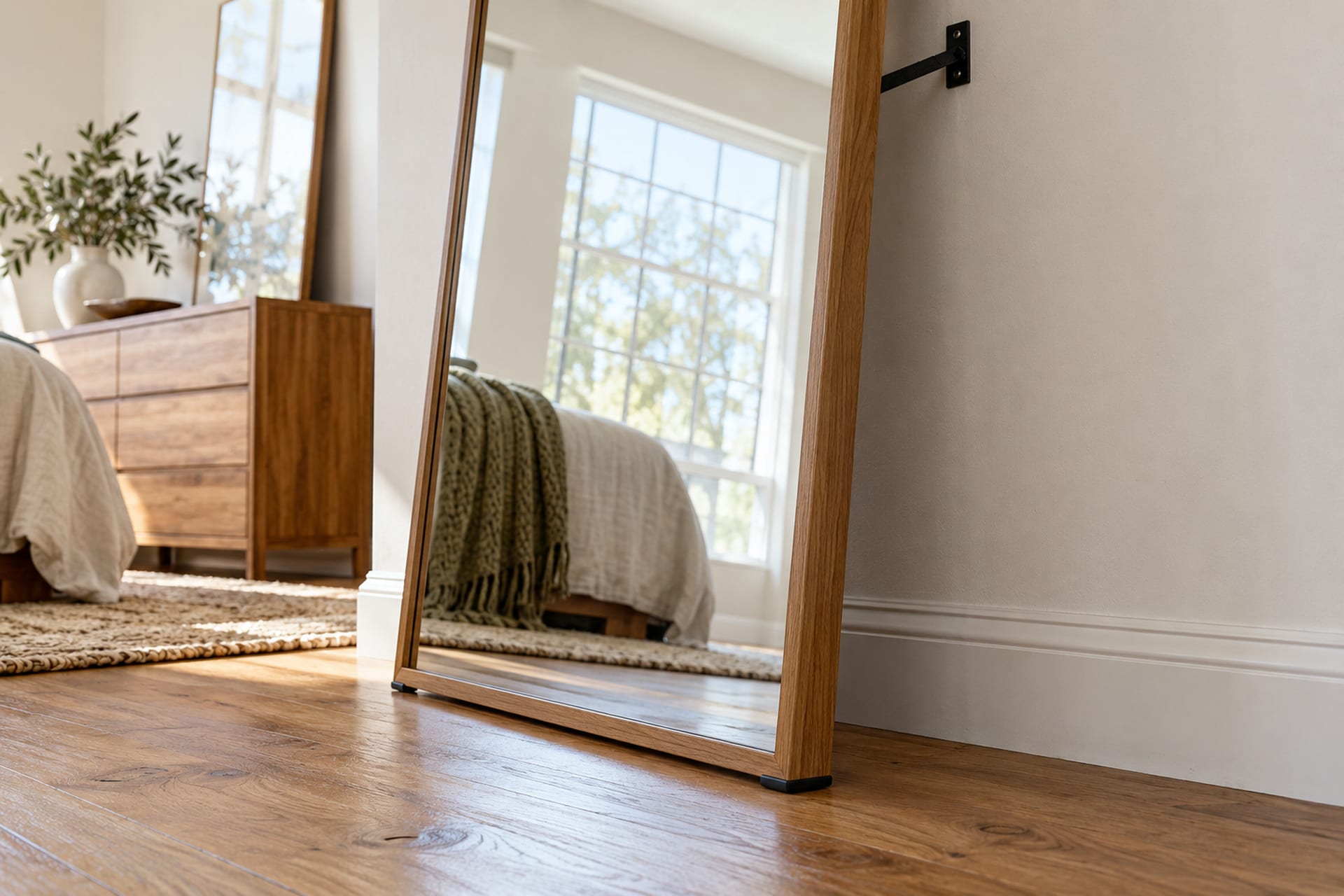
- Rubber or silicone furniture pads under both bottom corners. They are the simplest fix on wood, tile and laminate. The hero photo above shows one under the front corner.
- Non-slip rug pad or shelf liner cut into strips to fit under the bottom rail if the frame is thin.
- On carpet, the base tends to sink and creep; a thin rubber pad still helps, and the anti-tip strap matters more.
Felt pads do the opposite of what you want: they are made to help furniture slide. Take them off the base of a leaning mirror.
Block the base
If the room layout allows, block the base with a heavy piece of furniture in front of one corner. These help, but they do not replace a strap.
How to Secure a Leaning Mirror: The Anti-Tip Strap
- Lean the mirror at its final angle and mark where the top of the frame touches the wall.
- Fix the wall end of an anti-tip strap, cable or small L-bracket just above or behind that point, into a stud if possible, otherwise into an anchor rated for the job.
- Fix the other end to the back of the frame near the top, into solid wood or metal, never into the mirror backing board alone.
- Pull the strap snug so there is very little slack. The mirror should not be able to move forward more than an inch or so.
Many floor mirrors include an anti-tip kit in the box; it often gets thrown away with the packaging. If yours did not have one, the furniture anti-tip kits sold for dressers and bookcases do the same job. A bracket like the one in the photo above is the tidiest option, because it is almost invisible from the front.
Freestanding Mirrors on Stands
Mirrors with a stand or easel back do not need a wall, but they are not tip-proof either. Tighten the side knobs or hinges so the angle cannot change on its own, keep the legs fully open, and place the mirror out of main walkways. If the stand feels light for the height of the mirror, strap it to the wall anyway.
Common Mistakes
- Hanging the mirror by the bottom of the frame or on one central nail.
- Trusting drywall anchors without checking their rating against the mirror's weight.
- Leaving felt pads under a leaning mirror.
- Leaning a mirror too far back to stop it rocking; it then slides.
- Throwing away the anti-tip kit.
A light, thin-framed mirror can simply hang on a door or on two screws, which avoids the leaning problem entirely; my list of cheap full-length mirrors is a good place to start if you want one. And if you are still deciding where it should go, I cover placement in where to put a full-length mirror in the bedroom.
Sources
- University of Illinois Physics, Ask the Van: Mirror, mirror, on the wall Why a mirror half your height is enough, and where its top and bottom edges go.
- The Physics Classroom: What portion of a mirror is required to view an image? You need mirror equal to half your height, whatever your distance from it.
- U.S. DOE Building America Solution Center: Advanced framing, minimum wall studs Wall studs traditionally spaced 16 inches on center.
- U.S. CPSC: Anchor It! The CPSC campaign on anchoring furniture and TVs to prevent tip-over injuries to children.
Keep reading: Best full-length floor mirrors · Best over-the-door mirrors · How to hang a heavy mirror · How to hang a mirror on a door
The MirroRank letter
New mirror picks, sizing and lighting tips from Joan, about once a month.