Mirror guide
The Best Lighting for Makeup: Color Temperature, CRI and Where to Put It
 By Joan Bardot · Updated 5 sources cited
On this page
- What Is the Best Lighting for Makeup?
- Color Temperature: What 2700K to 6500K Does to Your Foundation
- What Is CRI, and Why 90 Is the Floor for Makeup
- Warm or Cool Light for Makeup?
- Where the Light Should Come From
- Is Natural Daylight Best for Makeup?
- Best Light Bulbs for Makeup: What to Buy
- My Makeup Lighting Checklist
Most makeup mistakes I see are not technique mistakes. They are lighting mistakes. Foundation that matched at the vanity looks orange by the office window, blush that seemed soft at home turns into two red stripes in daylight, and concealer that hid everything in the bathroom suddenly shows its edges.
The fix is not a better brush. It is light with the right color, the right quality and the right direction. If you want the shortcut, a good lighted makeup mirror puts all three in one place. If you want to understand what to look for, or set up your own vanity lighting, this guide covers it number by number.
What Is the Best Lighting for Makeup?
The best lighting for makeup is bright, even, neutral white light that falls on the front of your face. In practice that means three things working together, and missing any one of them is enough to throw your makeup off.
- Color temperature, measured in kelvin (K). It describes whether white light looks warm and yellow, neutral, or cool and blue.
- Color rendering, measured as CRI. It describes how faithfully the light shows the colors of your skin and your products.
- Direction. Where the light comes from decides whether you see your face evenly or through a mask of shadows.
Brightness is the easy part: being able to dim a light is more useful than raw power.
Color Temperature: What 2700K to 6500K Does to Your Foundation
Every white light has a tint. Lower kelvin numbers look warmer and more yellow, higher numbers look cooler and bluer. Your eyes adapt to whatever light you stand in within a few minutes, which is exactly why a wrong color temperature is so sneaky: the room looks normal to you, but every color you apply is being corrected for a tint you no longer notice.
| Color temperature | What it looks like | What it does to makeup | Use it for |
|---|---|---|---|
| 2700K | Soft, yellow, like an old incandescent bulb | Hides redness and warms everything, so you tend to overdo bronzer, blush and a too-deep foundation | A final check for evening plans, not for applying |
| 3000K | Warm white, common in bathrooms | Still flattering and still forgiving, which means it still lets mistakes through | Ambient room light |
| 3500K | Warm-neutral | Better, but warm undertones still look stronger than they are | An acceptable compromise if the fixture is shared |
| 4000K | Neutral white | Shows skin close to how it looks in indoor daylight; my starting point for applying | Applying foundation, concealer, brows |
| 5000K | Bright daylight-white | Close to direct midday sun; shows texture, patchiness and blending lines clearly | Color matching, checking your blend |
| 6500K | Cool, slightly blue, like an overcast sky | Makes skin look paler and grayer, so you tend to add too much warmth and coverage | Spotting dark circles and redness, not for color |
For reference, direct midday sun is usually given as roughly 5000K to 5500K and an overcast sky as 6500K and above. That is why a 4000K to 5000K light is the sweet spot: it behaves like daylight without the blue cast of a cloudy window.
What Is CRI, and Why 90 Is the Floor for Makeup
CRI stands for color rendering index. It is a score from 0 to 100 that says how accurately a light source shows colors compared with a reference light of the same color temperature (sunlight or an incandescent-type source, both of which score 100). The method comes from the CIE, the international commission on illumination, in its publication CIE 13.3.
The headline number, called Ra, is an average of eight fairly muted test colors. That is the catch for makeup. Skin, lips and blush depend heavily on reds, and saturated red is measured separately as R9, which is not part of the average. A bulb can score a respectable 82 overall and still render reds poorly, which is how you end up with a lipstick that looks brick-colored at home and bright pink outside.
What the numbers mean in practice
- CRI 80 to 85: the standard for ordinary LED bulbs. Fine for a hallway, not for matching foundation.
- CRI 90 or higher: the minimum I would use for makeup. Skin tones look natural and redness is visible.
- CRI 95 or higher with a high R9: what professional makeup and photo lights aim for.
A useful shortcut on US shelves: California's Title 24 energy code (Joint Appendix 8) requires a CRI of at least 90 and an R9 of at least 50 for qualifying lamps, so a bulb marked JA8 or Title 24 compliant has already cleared both bars.
Warm or Cool Light for Makeup?
Neither extreme. Warm light (2700K to 3000K) is flattering, and that is the problem: it softens redness, hides uneven blending and makes warm products look weaker, so most people reach for more bronzer and a deeper foundation than they need. Step into daylight and it all shows.
Cool light (6500K) does the opposite. Skin looks paler and slightly gray, under-eye shadows look deeper, and the natural reaction is to add coverage and warmth. Outdoors, that reads as heavy and orange.
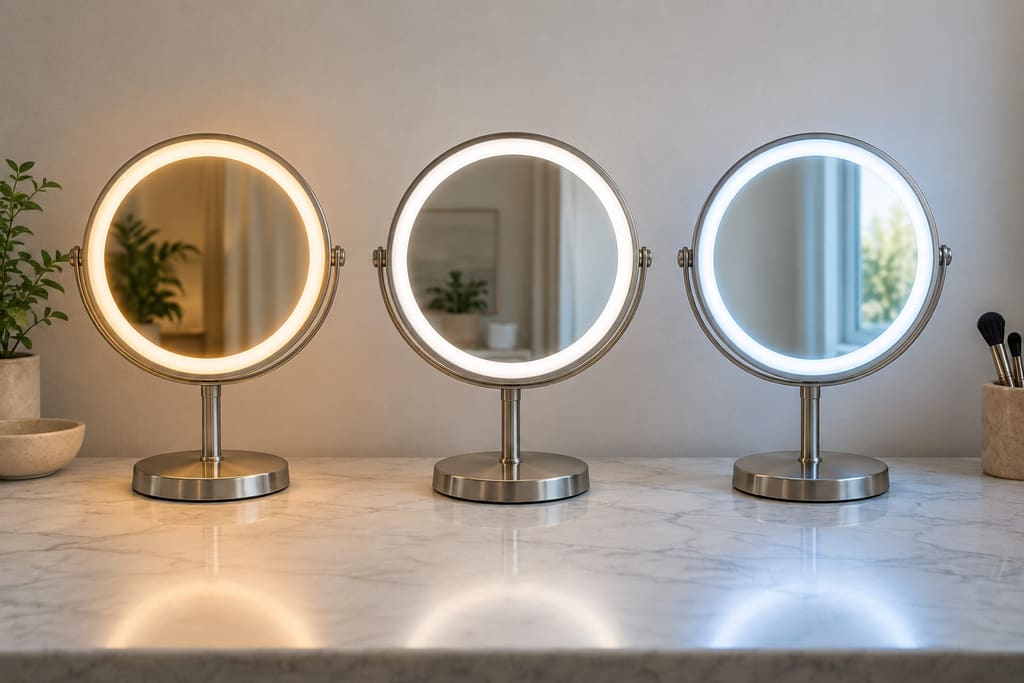
Neutral white between 4000K and 5000K avoids both traps. The one exception is when you know exactly where you will be seen. For an evening under warm restaurant light, do the work in neutral light, then glance at your face under a warm lamp before you go. Many lighted vanity mirrors have warm, neutral and cool settings for exactly this reason: apply in neutral, check in the other two.
Where the Light Should Come From
Direction is the part most bathrooms get wrong. A single fixture in the ceiling, or a bar mounted high above the mirror, lights the top of your head and the top of your cheekbones. Everything below a ridge goes into shadow: the eye sockets, under the nose, under the jaw. You then conceal shadows that are not on your face, only in your lighting.
Side lights at eye level
The classic solution is a light on each side of the mirror, centered roughly at eye level. Two vertical sconces or light bars, one on each side, cross-light your face so that each one fills in the shadows the other would leave. This is the setup I would choose for any vanity where you can choose.
Ring lights and lighted mirrors
A mirror with light built into its frame does the same job in a single object. The light comes from all around the glass and lands on your face from the front, which is why lighted mirrors work so well even in rooms with poor overhead light. Hollywood-style frames with a row of bulbs, and slim LED rings, both work; what matters is that the light is diffused and that you can pick a neutral color. For a dedicated vanity on the wall, a wall-mounted lighted makeup mirror on an extending arm brings that front light right to your face.
Why overhead light alone fails
Overhead light is fine as ambient light. Used alone, it creates the shadows described above, and ceiling fixtures are usually warm too. Keep it on for the room, but add front light for the work.
Is Natural Daylight Best for Makeup?
Indirect daylight is still the gold standard for checking color, because it is the light most people will see you in. The key word is indirect. Sitting face-on to a window works beautifully. Sitting with the window beside you lights half your face and leaves the other half in shade, which is how one cheek ends up with twice the blush of the other.
- Face the window, with the mirror between you and the glass, or with the window behind the mirror.
- Avoid direct sun on your face. It is harsh, it changes minute by minute and it makes you squint.
- North-facing windows (in the northern hemisphere) give the steadiest light through the day, because they never take direct sun.
- Watch the clock. Early morning and late afternoon daylight is much warmer than midday light. If you get ready at 6 a.m. in winter, you are not working in daylight at all, and an artificial neutral light is the more reliable choice.
The practical answer for most people is both: a neutral, high-CRI light that works at any hour, and a quick look by a window before leaving the house.
Best Light Bulbs for Makeup: What to Buy
If you are lighting a vanity yourself rather than buying a lighted mirror, these are the specifications I would put on the shopping list.
The specs that matter
- LED, CRI 90 or higher. Look for R9 of 50 or more, or a JA8 mark.
- 4000K to 5000K, or a tunable (adjustable white) bulb that covers that range.
- Dimmable, and on a dimmer switch that is rated for LED, to avoid flicker.
- Frosted or diffused. Clear filament bulbs at face height are glaring and leave hard reflections in your eyes.
- The same bulb in every socket. Mixing brands, or even batches, can mix slightly different whites, and mixed color temperatures make color matching harder.
When a lighted mirror is the simpler answer
If rewiring the bathroom is not an option, or you rent, a lighted mirror solves color, quality and direction in one go. Two things I check before buying one: that the maker states a neutral setting (or adjustable color temperature), and that the light is diffused behind a frosted surface rather than bare LED dots. A magnifying side helps for detail work; how strong it should be is covered in my guide to what magnification a makeup mirror should be.
My Makeup Lighting Checklist
- Light from the front or from both sides, at roughly eye level.
- Neutral white, 4000K to 5000K, for application.
- CRI 90 or higher; R9 50 or higher if it is listed.
- Diffused light, no bare points shining into your eyes.
- Overhead light on for the room, never as your only source.
- A final look in the light you will actually be seen in.
Curious why the magnifying side of a makeup mirror curves the way it does? I explain it in are makeup mirrors concave or convex.
Sources
- CIE: CIE 13.3-1995, Method of measuring and specifying colour rendering properties of light sources The CRI method; the general index is calculated from eight test colour samples.
- California Energy Commission: Residential Lighting, JA8 Compliance fact sheet Title 24 Joint Appendix 8 requires a CRI of 90 or above and an R9 of 50 or above.
- FTC: The Lighting Facts label, questions and answers for manufacturers What the label must show: brightness in lumens, yearly energy cost, life, light appearance in kelvin and wattage.
- FTC Consumer Advice: Shopping for light bulbs Lumens as the measure of brightness and the warm to cool light appearance scale.
- NKBA: Bathroom Planning Guidelines with Access Standards Guideline 25: task lighting at the vanity beside the mirror and at eye level.
Related: Best lighted makeup mirrors · Best lighted vanity mirrors · Wall-mounted makeup mirrors · What magnification should a makeup mirror be?
The MirroRank letter
New mirror picks, sizing and lighting tips from Joan, about once a month.