Mirror guide
Mirror in the Dining Room: Where to Put It and How Big
 By Joan Bardot · Updated 3 sources cited
On this page
- Should You Hang a Mirror in the Dining Room?
- Where to Put a Mirror in a Dining Room
- What Size Mirror for a Dining Room?
- What a Dining Room Mirror Should Reflect
- Floor Mirror or Wall Mirror in a Dining Room?
- What Shape Mirror Suits a Dining Room?
- Feng Shui and Vastu: What the Traditions Say
- Dining Room Mirror FAQ
A mirror is one of the few things you can add to a dining room that changes both the light and the sense of space at once. Put it in the right spot and the room feels wider, the pendant light seems to glow twice, and the evening table looks more inviting. Put it in the wrong spot and every guest spends dinner watching themselves chew.
This guide covers where a dining room mirror works, how big it should be next to your table or sideboard, and what it should and should not reflect. If you already know you want a tall leaning piece, my full-length floor mirror picks are a good place to start, and for a framed statement piece over a buffet, see the decorative mirrors I recommend.
Should You Hang a Mirror in the Dining Room?
Yes, in most homes it is one of the best rooms for one. Dining rooms are often the darkest room on the ground floor, they tend to have one big empty wall, and they are used in the evening when light matters most. A mirror answers all three: it bounces daylight during the day and doubles the warm light from a pendant or candles at night.
The one real drawback is self-consciousness. People sitting at a table look straight ahead, and a mirror at seated eye level means someone is always facing their own reflection. The placement rules below are mostly about avoiding that while keeping the light and space benefits.
Where to Put a Mirror in a Dining Room
Above the Sideboard or Buffet
This is my first choice in almost every dining room. The sideboard anchors the mirror visually, gives you a surface for a lamp or a pair of candlesticks that the mirror then doubles, and keeps the glass away from chair backs. It is also the spot that looks finished with the least effort.
Center the mirror on the sideboard, not on the wall. If the sideboard is off-center on the wall, the mirror follows the furniture.
On a Wall at a Right Angle to the Window
A mirror on a side wall catches daylight at an angle and spreads it across the room, which is what you want in a north-facing or narrow space. A mirror directly opposite a window doubles the view, which is lovely, but check it at the hour you actually eat: low evening sun bounced straight back can land in the eyes of whoever sits with their back to the window.
On the Long Wall Beside the Table
In a narrow room, a mirror on the long wall makes the space read as wider. The catch is that guests on the far side face it. Most adults sitting on a standard dining chair have their eyes roughly 45 to 50 inches off the floor, so if the bottom edge of the mirror sits above that line, the people at the table see the room, the light and the ceiling rather than themselves. A horizontal mirror hung high works well here.
Behind a Bar Cart or Console
A smaller mirror behind a bar cart picks up glassware and bottles and turns a corner into a small focal point. It is a good option when the main walls are taken by a window and a doorway.
At the End of a Long, Narrow Room
A mirror on the short end wall makes a galley-shaped dining room feel less like a corridor. Center it on the table's long axis so the reflection of the pendant lines up with the real one.
What Size Mirror for a Dining Room?
Size the mirror against the furniture under it, not against the wall. The decorator's rule I use is a mirror about two-thirds to three-quarters the width of the sideboard or table below, so the furniture always reads as wider than the glass above it. A mirror wider than the furniture looks like it is about to slide off.
| Furniture below | Mirror width (2/3 to 3/4) | Where the bottom edge goes |
|---|---|---|
| 48 inch sideboard | 32 to 36 inches | 6 to 10 inches above the top |
| 60 inch sideboard | 40 to 45 inches | 6 to 10 inches above the top |
| 72 inch sideboard | 48 to 54 inches | 6 to 10 inches above the top |
| 84 inch table (mirror on the long wall) | 56 to 63 inches | Above seated eye level, about 50 inches or higher |
For height, a floor mirror in a dining room should be tall enough to read as a deliberate piece: most full-length mirrors run around 60 to 70 inches, which suits a standard 8-foot ceiling. With a wall mirror, leave the top edge well clear of the ceiling and any crown molding so it does not look jammed in.
Mind the Weight
Big mirrors are heavier than people expect. Quarter-inch glass weighs roughly 3 pounds per square foot before the frame, so a 36 by 48 inch mirror (12 square feet) carries close to 40 pounds of glass alone. Anything that size goes on studs or rated anchors, never on a single nail. My guide on how to hang a heavy mirror covers French cleats, Z-bars and the right anchors for drywall and plaster.
What a Dining Room Mirror Should Reflect
A mirror doubles whatever it faces, so before you drill, decide what you want to see twice. Good things to reflect:
- A window or a view, for daylight and a sense of depth.
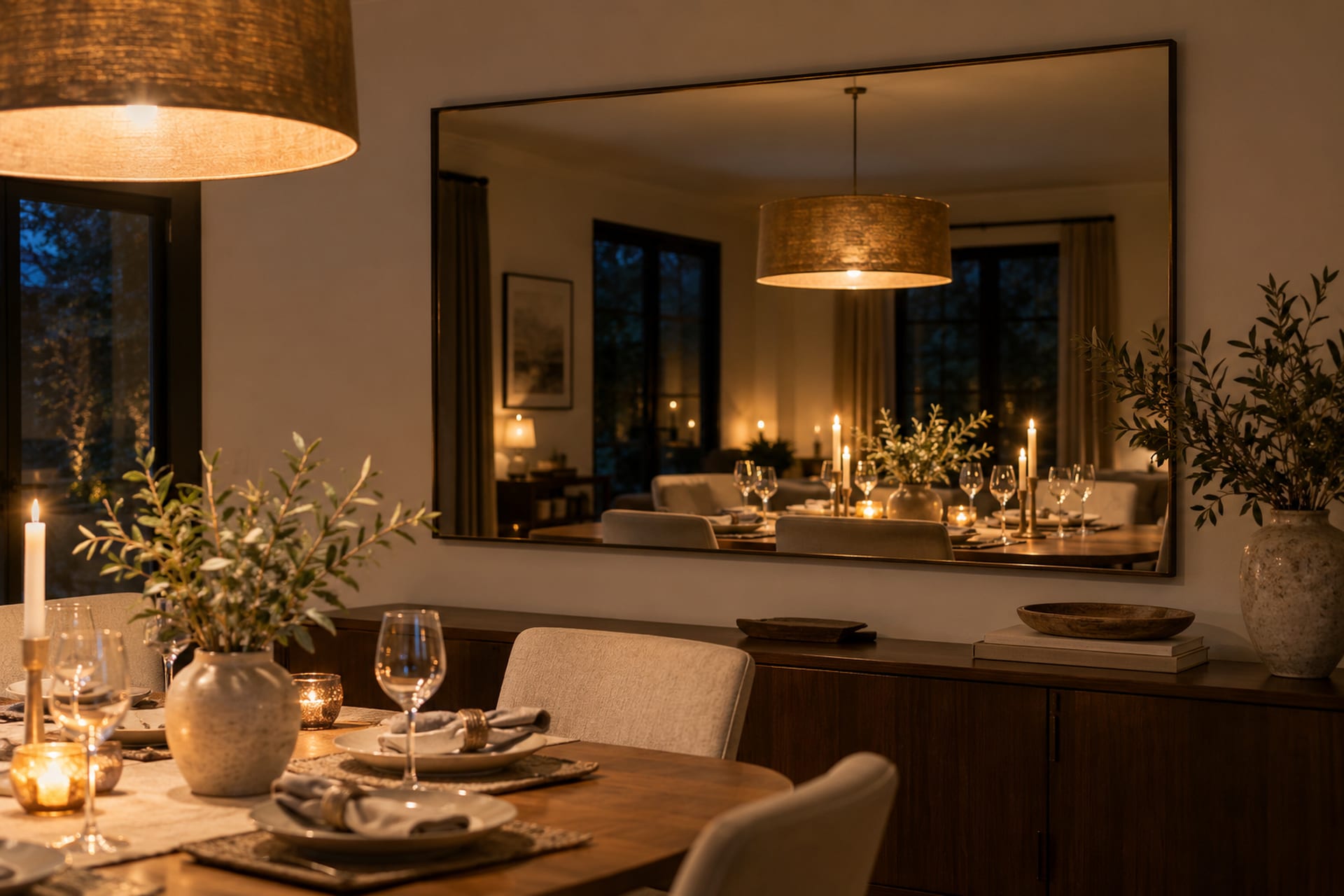
- The pendant light or chandelier, which is the classic evening effect in the photo above.
- Art on the opposite wall, so one good piece works twice.
- The set table, when you entertain often and like the extended-table look.
What Not to Reflect
- The kitchen pass-through or counters. Dirty pans become part of the decor. Steam near an open kitchen can also damage a mirror's silver backing over time and leave dark spots at the edges.
- Clutter: a coat pile, the mail drop, a busy bookcase.
- The TV, which also bounces screen glare around the room.
- A doorway to a bathroom or laundry, which pulls the eye away from the table.
- The guests themselves at seated eye level, as explained above.
Floor Mirror or Wall Mirror in a Dining Room?
Both work. The choice usually comes down to how much floor you can spare behind the chairs.
| Leaning floor mirror | Wall-hung mirror | |
|---|---|---|
| Best for | Large rooms, renters, a relaxed look | Small rooms, above a sideboard, a formal look |
| Floor space | Takes 10 to 20 inches of depth at the base | None |
| Installation | No drilling for the lean, but it should still be anchored | Studs or rated anchors |
| Risk | Chairs knocking the base, tipping | Wrong height, too-small hardware |
| Moving it later | Easy | Patch and repaint |
A floor mirror needs room behind the chairs. Most designers plan at least 36 inches between the table edge and the wall so a chair can be pulled out, and more if people walk behind seated guests. A leaning mirror eats into that space, so it belongs on a wall away from the table or in a corner, not right behind a row of chairs. If your floor mirror keeps creeping on hardwood or tile, my guide on keeping a full-length mirror from sliding has the fixes.
What Shape Mirror Suits a Dining Room?
Echoing the table is the safe choice: a rectangular or horizontal mirror over a rectangular table and a long sideboard, a round mirror near a round table. Contrast works too if it is deliberate, such as a round mirror over a long, low buffet, which softens all the straight lines.
Arched mirrors suit a floor lean because the curve stops a tall piece from looking like a door. Frame finish matters more than style: pick up a metal already in the room, like the pendant, the cabinet pulls or the candlesticks, and the mirror will look planned.
Feng Shui and Vastu: What the Traditions Say
Many people search for this, so here is the short version. Feng shui practitioners generally treat the dining room as one of the most favorable places for a mirror: their belief is that a mirror reflecting the dining table symbolically doubles the food on it, and with it the household's abundance. Vastu guidance, as its practitioners describe it, tends to favor mirrors on the north or east walls.
These are traditions and beliefs, not design rules, and they do not contradict the practical advice above. If you follow either one, a mirror above the sideboard that reflects the table usually satisfies both the belief and the light.
Sources
- Guardian Glass: Physical properties of glass Float glass density and weight per thickness, the basis for roughly 3 pounds per square foot at a quarter inch.
- NKBA: Kitchen Planning Guidelines with Access Standards Guideline 8: 32 inches from table edge to wall with no traffic, 36 inches to edge past a seated diner, 44 inches to walk past.
- U.S. CPSC: Anchor It! Anchoring tall furniture to the wall to prevent tip-over injuries.
Dining Room Mirror FAQ
Yes. The dining room is one of the best rooms for a mirror because it is often dim, has a large blank wall and is used in the evening. A mirror spreads daylight and doubles the glow of a pendant or candles. Just keep it out of seated eye level on the walls guests face, and away from the kitchen pass-through.
Match the table or the furniture below it. A rectangular or horizontal mirror suits a rectangular table and a long sideboard, and a round mirror suits a round table. A round mirror over a long buffet is a good deliberate contrast. For a tall floor mirror, an arched top keeps it from looking like a door.
Avoid spots where it reflects the kitchen counters, clutter, the TV or a bathroom door, and walls where seated guests would face their own reflection at eye level. Avoid steamy areas next to an open kitchen, which can damage the silver backing, and anywhere a leaning mirror sits in the path of chairs being pushed back.
Feng shui practitioners generally see the dining room as a good place for a mirror. Their belief is that a mirror reflecting the dining table symbolically doubles the food and, with it, the household's abundance. It is a tradition rather than a design rule, and a mirror above the sideboard facing the table fits both the belief and good practical placement.
Yes, if the room has space for it. A leaning full-length mirror needs 10 to 20 inches of floor depth, so put it on a wall away from the chairs or in a corner, not directly behind seated guests. Anchor the top to the wall with an anti-tip strap, and use pads or a rubber mat if the base slides on hard floors.
Keep reading: where to put a mirror in the bedroom and living room, hanging a heavy mirror safely, the best full-length floor mirrors and decorative mirrors for a statement wall.
The MirroRank letter
New mirror picks, sizing and lighting tips from Joan, about once a month.